
Household chemicals at home: organising storage and clear instructions
An organised utility cupboard is not about matching bottles, but identifiable products, retained warnings and avoiding dangerous guesses.
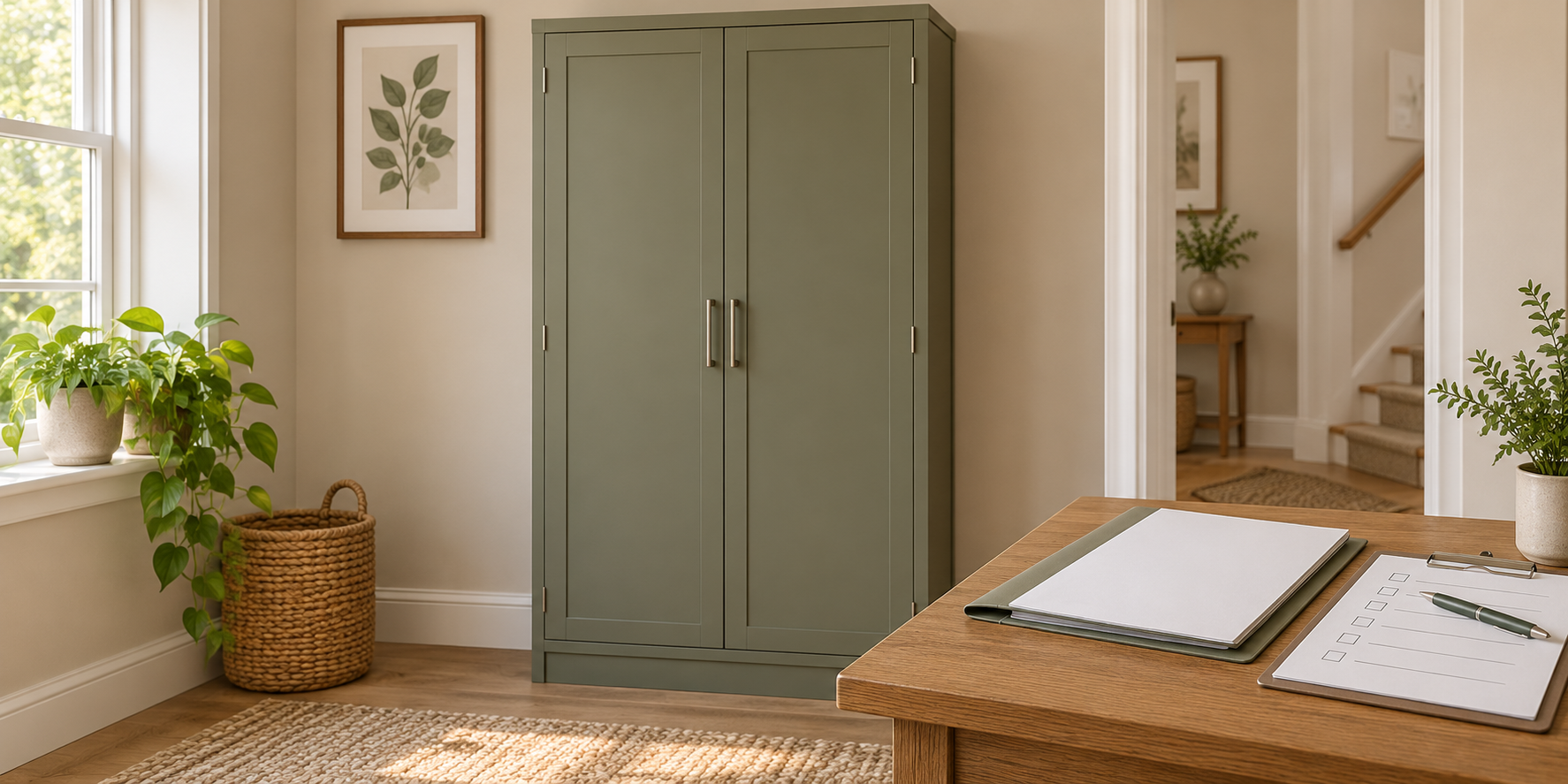
Neutral editorial illustration created with AI: a closed utility cupboard and a folder of instructions. This is not actual product labelling, guidance on chemical compatibility or confirmation that a particular storage location is safe.
In a tidy apartment, household chemicals are often arranged for appearances: matching containers, an unobtrusive shelf and a small reserve “just in case”. Safe handling depends on something else: can the product be identified accurately, its restrictions read and a child prevented from reaching it? An attractive container without its original label deprives the next person of information needed before using the product, not after a mistake.
The homeowner's task is not to create a home laboratory or find the “strongest” mixture. A simple system is needed: suitable products in original containers, understandable instructions, considered storage and clear action when a question or incident arises. Below is an editorial framework based on official Spanish recommendations. It contains no recipes, dosages, neutralisation methods or medical treatment.
Seek professional help after an incident involving a chemical product. Official Spanish sources give the emergency number 112 and the Instituto Nacional de Toxicología y Ciencias Forenses number, 91 562 04 20. If accidental ingestion is suspected, do not delay calling to look for a home treatment. Follow the specialist's instructions; do not experiment with chemicals.
Why original packaging matters more than decorative containers
The Ministerio de Sanidad recommends storing cleaning products separately from food, keeping their original packaging and following label warnings. Its child poisoning prevention leaflet also emphasises inaccessible storage, closing containers after use and never using water or other drinks bottles for chemicals.
For household organisation, the practical conclusion is simple: do not transfer a product into an attractive bottle merely to make the shelf uniform. A handwritten “for the bathroom” does not replace the manufacturer's information. It does not tell the next person the composition, restrictions, intended use or necessary precautions. Keep the original label legible; any additional household reminder should accompany it, not replace it with new labelling.
If an unknown container remains in a recently purchased apartment, do not try to identify its contents by colour, smell or a test on a surface. The old drink's name on a bottle does not describe the liquid now inside it. Do not hand it to a cleaner saying “I think this is floor cleaner”. Until a safe handling procedure has been established, it must not become part of the ordinary cleaning kit.
The label is a starting point, not decoration
On the page from Comunidad de Madrid about chemical products, the purpose of labelling is explained: hazard warnings, precautions and information about use. The service recommends reading the label, not mixing chemical products and not buying products marked for professional use for domestic purposes. These recommendations do not replace a particular manufacturer's instructions or mean that every household product suits every surface.
Before buying, ask three questions: what task is the product for, can you follow its conditions of use and is there a suitable place to store it? If the instructions are unclear, ask the seller or manufacturer before use. Do not choose solely because the brand is familiar: packaging within one range may relate to different tasks. The particular product matters, not a general impression of the brand.
If the label's language is difficult, prepare an understandable translation of the warnings for the adult who will use the product. Keep the original alongside the translation and do not reduce restrictions to “ordinary chemicals”. An unclear symbol or instruction is a reason to ask, not guess. A homemade reminder must not introduce permissions that the manufacturer has not given.
Review supplies without opening or mixing them
Begin by reviewing existing containers without transferring liquids or combining leftovers. Record the name, intended purpose, whether the label is legible and any question requiring a decision. A short list is sufficient for household organisation; do not invent a chemical compatibility table from assumptions. If a container is damaged or shows leakage, do not turn ordinary sorting into an attempt to manage a chemical incident yourself.
Mark separately on the list products no longer needed or whose purpose is unknown. “Mark on the list” does not mean put them together into a new container. Ask the relevant service or manufacturer how to handle this particular product and packaging. Do not pour out leftovers to clear space quickly: the official Comunidad de Madrid material warns against disposing of chemical products down drains.
Before buying a replacement, check what is already at home. This organisational step can reduce confusion; it is not a promise of a particular saving or shelf life. Do not retain unnecessary products merely because every bottle “may come in useful”. The clearer the purpose of the existing kit, the easier it is to explain to another adult without a long account of miscellaneous leftovers.
Plan storage for the household that actually lives there
Check not only the chosen cupboard but also the product's journey after use. It may be left on the floor, beside the sink or near food while someone answers a call. Household arrangements must include returning the container to a suitable place, not merely a beautiful photograph of a closed cupboard. For children, the official leaflet's criterion is inaccessibility, not hope that a child “already knows not to touch”.
Adults should agree who is responsible for storage and where keys are kept if a lockable cupboard is used. Do not leave this information with just one person who is often absent. Equally, unrestricted access for every visitor is not a requirement of hospitality. Someone who does not need the product does not need uncontrolled access to household supplies.
Separation from food must remain clear after shopping, cleaning and rearranging. Do not use the same bag for food and chemical leftovers when sorting a cupboard. If the storage location must change, compare its conditions with the instructions on the actual packaging. This article sets no universal temperature, spacing between all products or permission to store any assortment of substances together.
Arrange cleaning so that nobody invents “improved recipes”
The Instituto Nacional de Toxicología y Ciencias Forenses describes incidents involving cleaning products transferred to drinks containers or products mixed together. The institute warns that compositions may differ and advice for one exposure may not suit another. A specialist telephone consultation therefore cannot be replaced by a general internet text.
State the household rule briefly: do not mix products or add another substance to a ready-made product to strengthen its effect. Do not include a list of “permitted home combinations” in the reminder. If cleaning results are unsatisfactory, ask the manufacturer about the suitable product and method rather than complicating the process through experimentation. Packaging instructions take precedence over a friend's advice about a stronger effect.
Do not transfer one product's usage procedure to another. Check surface preparation, room conditions and protective measures against that product's own instructions. If the conditions cannot be met, do not start in the hope that brief use will be an exception. Owners benefit from deciding in advance which jobs can be done personally according to instructions and which require a specialist provider.
What to explain to a cleaner, guest or new resident
When handing over the home, show the storage area and explain which products are for ordinary use and which have unresolved questions. Do not present an unlabelled bottle as part of the kit. If a company does the cleaning, ask how its products are organised and what will remain in the apartment afterwards. Do not require it to use the previous owner's unknown leftovers to save money.
Agree a simple way of reporting problems: damaged packaging, an unreadable label or an unclear purpose means stop and ask, not look randomly for a substitute. In an incident, seeking emergency help must not wait for the owner's permission. The owner may organise household matters but must not become an intermediary who delays professional advice.
If people have different cleaning habits, discuss the actual procedure and documentation rather than argue about which product is “the safest in general”. A clear agreement is: keep original packaging, read this product's instructions, do not mix and return it to the agreed place. This helps avoid a situation where everyone assumes somebody else knows what is in the container.
Prepare information for the call without delaying help
Comunidad de Madrid recommends having label information available when seeking help and reporting the UFI code if shown: it helps the toxicology service identify the mixture. Do not search the whole home for it before calling or expose yourself further to retrieve packaging. Tell the specialist what information is available and what you do not know, and follow their questions.
Do not replace the exact name with “some chemical” if the label is already safely accessible. Nor should you invent the composition from appearances. An account of the circumstances must distinguish observation from assumption: what happened, which product is known and what remains unclear. This article does not diagnose from such information or offer a home treatment plan.
Do not recreate the incident to test it, mix leftovers “to find out the reaction” or attempt chemical neutralisation on random advice. Official materials emphasise professional consultation. In danger, do not expose yourself or others further for cleaning, photographs or saving belongings. The first task is obtaining appropriate help, not finishing the household job.
Update arrangements after a question or incident
Once competent services have resolved the urgent situation, consider which organisational gap accompanied it: unknown contents, lost instructions, accessible storage, confusion between similar packages or insufficient handover. Do not turn this review into your own medical conclusion. Its purpose is to improve the household process within the owner's control.
Keep relevant instructions and update the household reminder. If a particular product has been taken out of use, remove it from the ordinary supplies list. If storage conditions have changed, explain that to all adults who manage the home. Do not consider the task finished merely because a dangerous bottle has moved to another corner and one person now knows about it.
A reasonable result is a small, understandable set of products, retained labels, storage inaccessible to children and suitable for the products, no homemade mixtures and a clear route to help. This is no guarantee against incidents or a certificate for the home. It does, however, make it possible not to rely on memory, a container's appearance or the next person's guess.
Sources and scope of verification
On 29 October 2026, the following official Spanish materials were read: the Ministerio de Sanidad guidance on preventing adult poisoning, the leaflet on protecting children, page from Comunidad de Madrid about chemical products, and the INTCF material on cleaning products. Medical treatment plans, dosages and recipes from the sources are not reproduced here. Organising supplies and handing over information are editorial recommendations; particular products and premises were not inspected.
The material is for informational purposes only. Check the legal and financial terms of a specific transaction with relevant specialists.
Select real estateDiscuss with Laverna