
Urban planning certificate in Spain: checks before buying
How to check planning status, licences and proceedings before buying in Spain, with a municipality-specific example from València.
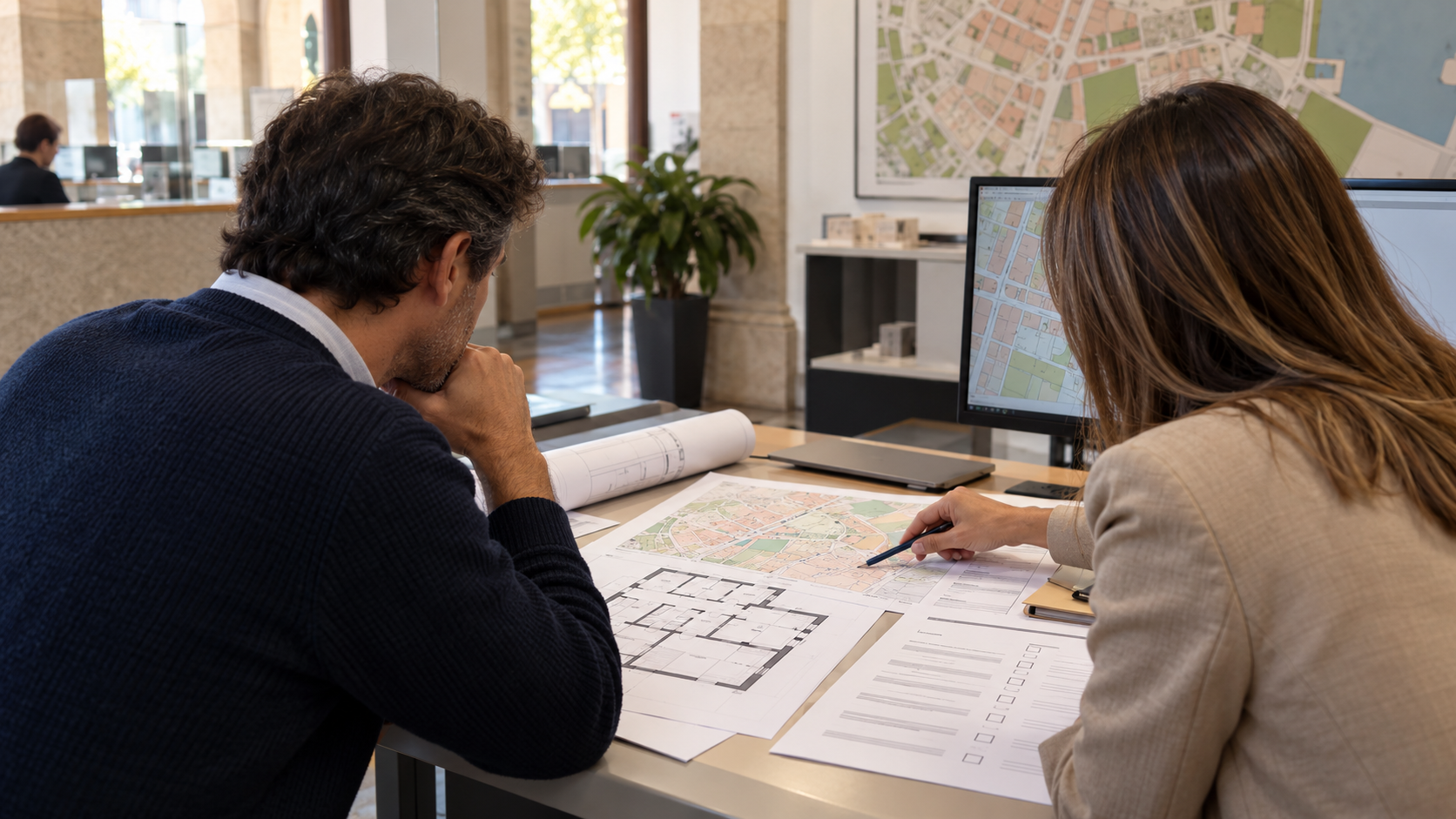
Neutral editorial illustration of two people reviewing plans and a map; it does not depict an official document, a specific municipality or a particular property.
Spanish terms used in this article have the following meanings: nota simple is an informational Land Registry extract; Registro de la Propiedad is the property-rights register, while Catastro is the cadastre; finca, in the registry context, means a registered property unit; ayuntamiento means the town or city council; expediente means an administrative case file; escritura is a notarial deed; certificados finales are completion certificates; and comunidad de propietarios is the owners’ association. Sede electrónica means an authority’s electronic portal. Cédula de Garantía Urbanística is an official document stating a plot’s planning status; certificado de circunstancias urbanísticas is a certificate of planning circumstances; informes de compatibilidad are reports on whether a proposed use is compatible with the applicable rules. The Spanish names are retained to help locate documents; their precise legal effect depends on the particular procedure.
A nota simple answers important Land Registry questions, but it does not replace a municipal urban-planning check. Before buying a house, plot or property with an altered layout, you need to establish the applicable plan, permitted use, licence records and any possible enforcement proceedings. The name of the required document and the request procedure depend on the municipality.
Why a Land Registry extract is not enough
The Registro describes rights and charges within its remit. The municipality deals with the planning regime, licences and compliance with the applicable planning rules. The fact that the owner shown in the nota simple is correct does not automatically confirm that an extension, tourist use or future enlargement is permitted.
The general national framework is set out in the consolidated Ley de Suelo y Rehabilitación Urbana approved by Real Decreto Legislativo 7/2015. Detailed categories, procedures and documents are also governed by autonomous-community and local rules. This article cannot be used as a universal set of instructions for every ayuntamiento.
How to formulate the request
Start with the precise finca, cadastral reference, address and a plan showing the property as it actually exists. Describe the question: the current use, a specific extension, the possibility of renovation or another proposed action. A general request asking whether “everything is legal” is often insufficient for a verifiable answer.
Ask an independent architect and lawyer which official document or expediente is needed: a planning report, certificate, copy of a licence, details of proceedings or another form of response. Terminology and legal effect may differ.
Municipal example: Cédula de Garantía Urbanística in València
As a specific example rather than a rule for Spain as a whole, the electronic office of València City Council publishes the Cédula de Garantía Urbanística procedure. For this València procedure, the official page’s applicant section identifies the plot owner or a duly accredited legal representative; the required documents include proof of ownership. The procedure description concerns plots on which construction or private use is permitted, and the document records urban-planning zoning and classification. The page also specifies the submission method, required documentation, a one-month issue period and a maximum validity of one year.
This example must not be transferred to Alicante, Calpe or another municipality, and it is not permission for a specific project. Even in València, the procedure must match the purpose of the request: the municipal electronic office separately publishes a certificado de circunstancias urbanísticas (this procedure excludes the historic centre) and informes de compatibilidad for other purposes. Before buying, a specialist should confirm the current procedure, the required documents and the meaning of the response for the precise address.
Planning rules and the property’s actual configuration
Compare the documents with what is physically present: number of storeys, terraces, garage, swimming pool, ancillary rooms and the stated use of rooms. Listing photographs and the cadastral plan are useful evidence for the review, but they are not permissions.
If the seller says work is “old” or “legalised”, request the particular document, its date, the issuing authority and the property to which it relates. Do not assess the legal effect of elapsed time by yourself: the significance of time limits and procedures should be determined by a suitably qualified specialist.
Current use and the buyer’s plans
Even if the current arrangement suits the seller, your intended use may require a different review. Permanent residence, division of a house, opening an office, letting, constructing a pool and glazing a terrace are different intentions. Record your plans before obtaining legal and technical advice.
Do not include an anticipated extension in your assessment of the plot’s usefulness until feasibility is confirmed. A renovation rendering and a contractor’s oral opinion do not replace a planning response and a project.
Documents to gather
- an up-to-date nota simple and cadastral information;
- the escritura and plans attached to available documents;
- licences for construction, use and completed alterations;
- technical projects and certificados finales where applicable;
- comunidad records for elements belonging to common property;
- written municipal responses or copies from the expediente;
- an independent architect’s report on the actual configuration.
The document set depends on the property type and location. The absence of one particular document name from this list does not prove a defect; a specialist must determine which document was required on the relevant date and under the relevant procedure.
Open proceedings and unresolved matters
If an administrative proceeding exists, establish its subject, stage, addressee and possible obligations. Do not stop at the expediente number. Obtain the documents and a legal explanation of their effect on the buyer and on the transaction terms.
If a written response will not arrive before a deposit is due, discuss the review deadline and an appropriate contractual condition. Do not replace a missing document with an intermediary’s assurance. The wording must precisely describe the required outcome and the consequences.
New build, resale property and land
For a property under construction, the project, permits and handover stage matter. For an existing home, compare the documents with the physical state. For an undeveloped plot, check the applicable regime, access, infrastructure and parameters, but do not treat them as a promise that any proposed project will be approved.
Do not transfer a check from one developer’s unit to another, or from one plot to its neighbour. Even adjoining fincas may have different boundaries, charges and technical conditions.
Who is responsible for the conclusion
A lawyer analyses rights, procedure and contractual consequences. An architect or another competent technician compares the physical property, project and regulatory parameters. The municipality provides answers within its remit. An agent may organise documents but should not replace independent professional conclusions.
Ask for the conclusion to list the documents examined, their dates and the limitations that remain. An unsupported statement that “everything is fine” is unsuitable as the basis for a substantial payment.
Final checklist
Attach only material that identifies the property unambiguously: cadastral reference, finca details, address, plan and description of the intended use. After receiving the response, check which question and date it addresses, which documents it cites and whether it contains qualifications. A statement about the current regime must not be turned into an indefinite guarantee or permission for a project that has not yet been submitted.
- The property is identified consistently in every document.
- The actual configuration is shown on a comparison plan.
- The buyer’s intended use is described before the request.
- The competent authority and required form of response are identified.
- Licences and proceedings are checked against the specific documents.
- Technical and legal conclusions are kept separate.
- Unresolved matters are reflected in the contract before payment.
An urban-planning check does not guarantee approval of a future project and does not replace the Registro, Catastro or a technical survey. It addresses a separate set of questions. This material was checked on 25 October 2026; municipal requirements must be reconfirmed for every address and intended use.
Official sources
- Official source: BOE: Real Decreto Legislativo 7/2015.
- València City Council: Cédula de Garantía Urbanística — a municipal example, not a general procedure for Spain.
- València City Council: Certificado de Circunstancias Urbanísticas (excluding the historic centre).
The material is for informational purposes only. Check the legal and financial terms of a specific transaction with relevant specialists.
Select real estateDiscuss with Laverna