
Children's pool accessories: what to check before use
A colourful accessory does not replace an adult. A practical process for preparing products, documents and family arrangements before visiting a communal pool.
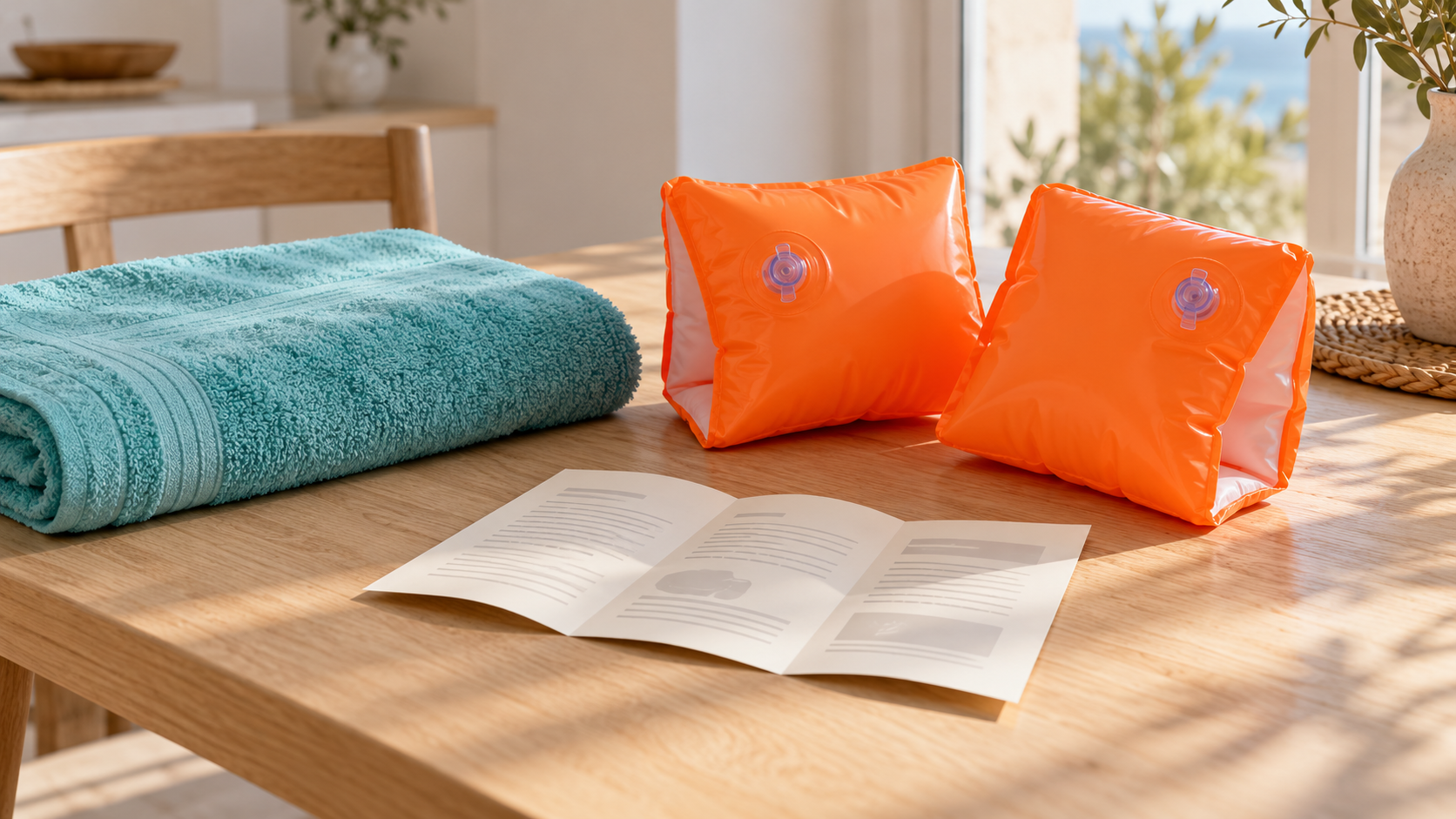
Neutral editorial AI illustration of pool preparations: generic accessories and an instruction sheet, with nobody in the water. It does not depict a verified product, lifesaving equipment or a method of using it.
An apartment with a communal pool often seems convenient for a family holiday. However, having a pool and colourful inflatable accessories does not resolve the question of a child's safety. Adults benefit from establishing beforehand exactly what has been bought, who the item is intended for, where the instructions are and how attention at the water will be organised. This is better done before leaving the apartment, not when the child is already waiting at the pool edge.
This article concerns preparing information and family arrangements, not swimming instruction or rescue. It does not assess a particular pool, establish whether a particular product is suitable or promise protection against drowning. In actual danger, follow the applicable directions of the responsible services; do not use a list of purchasing questions instead of seeking emergency help.
The main limitation highlighted by the official source
Consumo Responde, the official resource of Junta de Andalucía, stresses that children's flotation accessories do not replace constant adult supervision and do not themselves protect against drowning. The material recommends checking the instructions, warnings, manufacturer information and the product's age and weight range. Checking product information does not make it a substitute for an adult.
The source's recommendations concern the accessories it discusses. Here, we do not declare a single marking sufficient for every poolside product or transfer requirements for one type of product to another. What follows is an editorial preparation process: separate intended use from advertising, retain the instructions and make adults' arrangements clear. It is not a technical assessment or a complete set of bathing rules.
First identify the item, not its promise
Record the exact product name from the packaging and its intended use according to the instructions. Words such as “for water” or “children's”, or a picture of a smiling family, do not explain permitted use. Do not assume an inflatable item is lifesaving equipment because of its appearance. If its intended use cannot be established, clarify this with the seller or manufacturer before use rather than testing a guess on a child.
Do not combine different items into one “everything for swimming” category. Each item must retain its own limitations and instructions. Even if two products look similar in colour or size, that does not confirm identical conditions. For family preparation, identify what you intend to use and do not replace information about that particular product with general advice about a different purchase.
If an accessory came with the apartment or was left by previous guests, do not automatically consider it suitable. A missing receipt does not itself establish its condition, but a lack of clear identification and instructions leaves important questions unanswered. Do not present the assumption that “it was used before” as confirmation that it is suitable for another child and another situation.
Check who the instructions are intended for
Find the manufacturer's stated age and weight range and read it alongside the other limitations, not separately. Do not choose a product solely by the age shown on a price tag or by judging its size by eye. If the packaging, seller's listing and enclosed instructions disagree, do not choose the most convenient version: request clarification for the exact model.
Do not publish a child's information in a public review so strangers can choose a product for you. When asking the seller, provide only information that is genuinely necessary through an appropriate channel. A confident comment that something “suits everyone” cannot provide a specific recommendation. Another family's personal experience does not override the manufacturer's limitations.
Check that the adults who will be with the child understand the instructions. If the text is in an unfamiliar language or some warnings are unreadable, resolve this before going to the pool. Do not reduce a warning to one convenient sentence. A family note can identify an unresolved question, but cannot replace missing instructions.
Keep product information without turning your home into a document warehouse
Before discarding the packaging, retain the available manufacturer details, model designation and instructions. If you have proof of purchase, link it to the particular item. This helps you ask a precise question instead of searching from memory for “the blue armbands from the shop”. Do not attribute features to the product from an online photo of a similar item.
Make sure the relevant adult can quickly find the instructions without searching the entire family archive. A file link or clearly organised folder is more useful than dozens of unsorted screenshots. However, an image of the box does not replace readable text: check that the warnings are not cropped and relate to the actual item you have.
If the manufacturer publishes an updated explanation, retain it together with the model designation and date of your enquiry. Do not automatically apply the reply to other items. Ordinary consumer correspondence is not a safety certificate for a particular pool and does not relieve adults of the need to pay attention to the child.
Preparing a product must not become a DIY experiment
Look for preparation and use procedures in the instructions for the particular product. This article does not provide universal methods for inflation, fastening, repair or testing. Do not change the design or add improvised attachments to adapt an unsuitable item. If a required action is unclear, obtain clarification before use.
If you find damage, missing components or a mismatch with the description, do not test the consequences in the water with a child. Record the issue and contact the seller or manufacturer. Do not describe a visual examination as proof that every component works correctly. An item looking intact does not automatically answer questions about its purpose, condition or correct use.
When handing an accessory to another adult, pass on its information too. “Everything is ready” is too vague: it may mean only that the item has been taken out of the bag. It is better to explain which instructions have been read and which questions remain unresolved. Preparing the item and organising supervision are separate tasks.
Agree on adults' attention before the outing begins
Do not rely on an unspoken assumption that somebody in the group is watching the child. Before leaving, discuss who is directly responsible for supervision and how a need to hand over that role will be communicated. A homemade reminder is not a professional safety protocol, but may help avoid a situation where everyone believes someone else is responsible.
If an adult needs to step away, responsibility must not change only in that person's mind. The arrangement must be explicitly clear to another adult. Do not treat the presence of an accessory as a reason to relax attention. This article does not specify universal distances, checking intervals or numbers of children per adult: such figures must not be invented in place of actual rules and circumstances.
Do not ask the child to confirm that a product is safe or say that an adult can turn their attention elsewhere. A photograph, an “I know how” promise or a message in the family chat does not replace supervision. If clear arrangements cannot be made, do not substitute the purchase of another accessory for them.
The particular pool's rules are a separate source
Before using a communal pool, read the current rules for that specific place. Ask the responsible person which accessories are allowed and where questions should be directed. Do not transfer another development's rules to your own merely because the pools look similar. Permission to be in the pool area does not confirm the suitability of every product brought there.
Do not state that a lifeguard is present unless this has been checked. Even the presence of staff must not be used as a reason to regard ordinary accessories as protection against drowning. Family preparations must reflect actual conditions, not a promotional photograph of the development or accounts of last season.
If the rules are unclear or information conflicts, resolve the issue before using the item concerned. Do not try it on the basis that “nobody has forbidden it”. Owners benefit from keeping an up-to-date contact for the person responsible for the communal area, but should not promise guests permission on behalf of the community without grounds.
Prepare a short handover of information for guests
If relatives are coming to the apartment, explain beforehand which accessories belong to the family and where their instructions are kept. Do not present items left there as a set guaranteed to suit every child. Guests need to check suitability for the particular user themselves and agree on supervision arrangements, rather than relying on the apartment's equipment.
A guest note is best divided into three topics: information about the particular product, pool rules and contacts for clarification. Do not merge them into an advertising promise that “everything is safe for children”. Separately state that items being in a cupboard does not confirm they have been checked for the forthcoming use.
Do not ask guests to leave photos of children or detailed personal information in an open folder for accessory tracking. For organisational purposes, it is enough to know which item was handed over, which instructions are available and whether there are observations about its condition. If the issue concerns product safety, record the item's characteristics rather than creating an unnecessary archive of family information.
After use, preserve clarity as well as tidiness
Follow the particular product's instructions for subsequent care and storage. There is no universal method of drying, chemical treatment or repair here. If a question about condition arises after use, do not return the item to the shared set in the silent hope that the next adult will notice the problem.
Identify the unresolved issue and warn the responsible person. Do not attach your own “checked” label if all you have done is observe the exterior. For the next visit, it helps to know exactly what is known and what needs clarification. Neatly arranged accessories do not replace clear limitations and retained instructions.
Pool preparation does not end with a purchase. Its practical result is an accurately identified product, readable directions, no unresolved questions preventing use, and clear arrangements between adults. None of these points alone guarantees an absence of risk. Accessories remain supporting items, not a way to transfer responsibility for a child to them.
Source and limits of the review
On 30 October 2026, the following was read: the official Consumo Responde material on children's flotation accessories. Limited points on adult supervision, the absence of protection against drowning and the need to read information for the particular product were used. The remaining structure is editorial organisation of preparations. No specific child, product, pool or development's rules were assessed; rescue methods and technical tests are not covered.
The material is for informational purposes only. Check the legal and financial terms of a specific transaction with relevant specialists.
Select real estateDiscuss with Laverna