
Parking space and storage room when buying a home in Spain: what to check
How to check parking and storage when buying in Spain: finca, anejo, Land Registry, community rules, contract, access and handover.
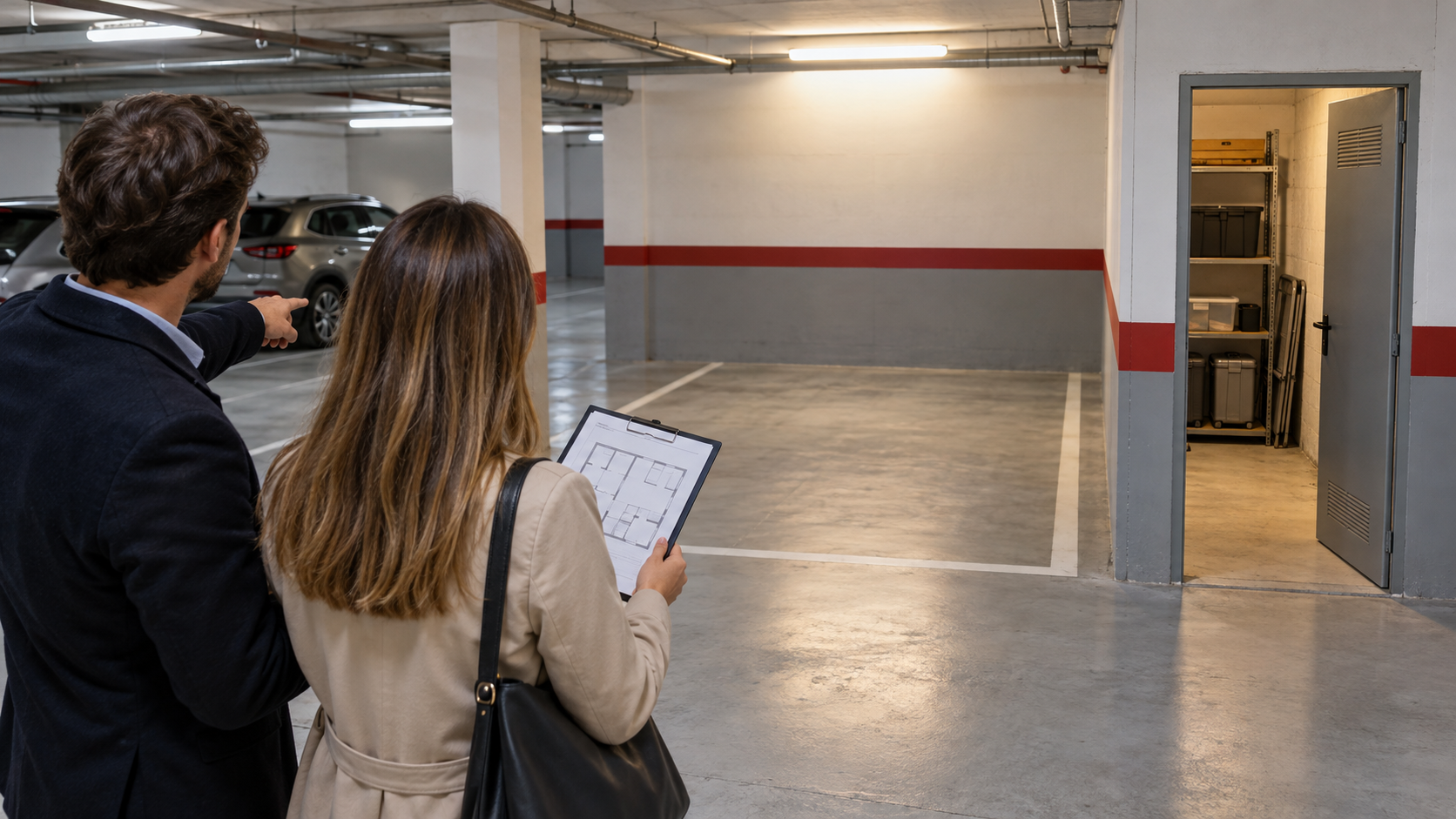
Neutral AI-generated editorial illustration; it does not depict a specific property for sale or confirm legal ownership.
A parking space and storage room are often shown with an apartment, but that does not mean the buyer acquires them on the same terms. Before paying a deposit, establish whether they are separate properties, appurtenances to the home or common areas subject to a right of use. Then compare the listing with the Land Registry, Catastro, community rules and draft contract.
Why “parking included” is not enough
The seller describes the practical package in the listing, while the legal composition of the purchase is set by the records. A space may have its own registry number, form part of the apartment description as an anejo inseparable, or remain a common part of the building used by a particular owner under community rules. A storage room may likewise be a separate finca, an appurtenance or a room whose legal status differs from its everyday use.
These arrangements are not interchangeable. Status affects the parties, precise description, allocation of price and expenses, ability to sell separately and restrictions requiring review. The buyer need not classify it personally: obtain the records and ask an independent lawyer to state the conclusion in writing.
Begin with precise identification
Record the space number, garage level, storage-room designation, entrances and physical boundaries. A photograph of the marked number helps the working file but does not replace a plan. At the viewing, check whether the number on the floor or door matches the seller's information. If an adjoining area is used, ask on what basis and whether it is included.
For every element, request an up-to-date nota simple or a document showing that it forms part of the home description. Compare owner, registry particulars, participation quota and encumbrances. If parking or storage is separately registered, review it separately: a clear extract for the apartment does not automatically describe another finca.
A cadastral reference helps connect the property to its physical location, but Catastro and Land Registry records serve different purposes. An inconsistency should not be explained by the agent's guess. Record it and refer it to specialists who can identify the required documents and whether the intended package can be transferred.
Separate finca and anejo inseparable
If a space is separately registered, the draft contract should identify it beyond confusion with another. Check whether the same owner is selling it, whether it has separate encumbrances and whether it will appear in the notarial deed. A specialist adviser must confirm allocation of the combined price and the tax treatment for the particular transaction.
If parking or storage is recorded as an inseparable appurtenance, do not assume it may later be sold freely on its own. Check the title wording and building rules. The advertising claim “it can be rented to a neighbour” does not prove that a separate transfer of the right is allowed.
The reverse also occurs: the seller has used a room for years, but it is absent from the apartment records. Length of use alone does not prove ownership. Before payment, establish the basis: a community resolution, contract, allocation of common areas or another arrangement. An oral promise that the familiar practice will continue after ownership changes is too weak a basis for the purchase budget.
What to check with the community of owners
Through the seller or administrator, request the statutes, internal rules and recent minutes. They may regulate access, prohibited stored items, gates, electric-vehicle charging, common passageways and planned works. The Horizontal Property Law provides the general framework, but each building has its own documents and resolutions.
Establish how charges are assessed: separately for each finca, through the apartment quota or under another approved method. Request debt and approved derrama information for the entire package. A certificate for the apartment should not automatically be treated as proof that a separately registered garage has no debt.
Inspect access: gate width, turning radius, clearance, slope, remote control and route to the lift. Test it with the actual vehicle where possible and agreed. The stated area says nothing about a column by the door, a neighbouring car or difficulty exiting.
Storage room: area, ventilation and permitted use
Record number, location and dimensions, but do not include storage in living area. Inspect damp, ventilation, door, lock, services and leak marks. The seller's belongings may conceal walls and floor, so a repeat inspection after clearance or a handover condition is useful.
Ask what the building and safety rules prohibit storing. A storage room does not become a workshop, bedroom or office merely because it has lighting. Any proposed change of use requires a separate check; this article does not confirm that a particular room may be converted.
How to describe the package in the contract
List the apartment, space and storage room in the reservation and main contract using the identifiers confirmed by the lawyer. State what comes with them: remotes, keys, cabinets or fixed equipment. If the price covers several properties, the adviser must agree how it appears in the documents and calculations.
Before the deposit, decide what happens if one element cannot be transferred on the stated terms. The buyer should not invent a consequence afterwards but agree it in advance in a reviewed contract. An independent lawyer drafts the condition and repayment provision to match the transaction records.
Practical checklist
- Numbers and locations match the areas shown.
- Registry records were obtained for every separate property.
- Owner, encumbrances and community debts were checked.
- It is clear whether each element is a finca, anejo or right of use.
- Access, storage rules and planned works were reviewed.
- The practical suitability of the space and storage condition were assessed.
- Every element appears in the draft contract and notarial documents.
- Keys and remotes are listed in the handover record.
A sound review does not complicate the purchase; it removes ambiguity. Compare offers by the confirmed package, not the number of icons in a listing. This material was checked against the consolidated Ley de Propiedad Horizontal on BOE and the official Colegio de Registradores services on 25 October 2026; an independent specialist decides the position for a particular property.
The material is for informational purposes only. Check the legal and financial terms of a specific transaction with relevant specialists.
Select real estateDiscuss with Laverna