The refrigerator after a power outage: collecting facts and organising a check
Restored power does not settle the question of food. A practical approach to recording circumstances and passing on information without tasting food to check it.
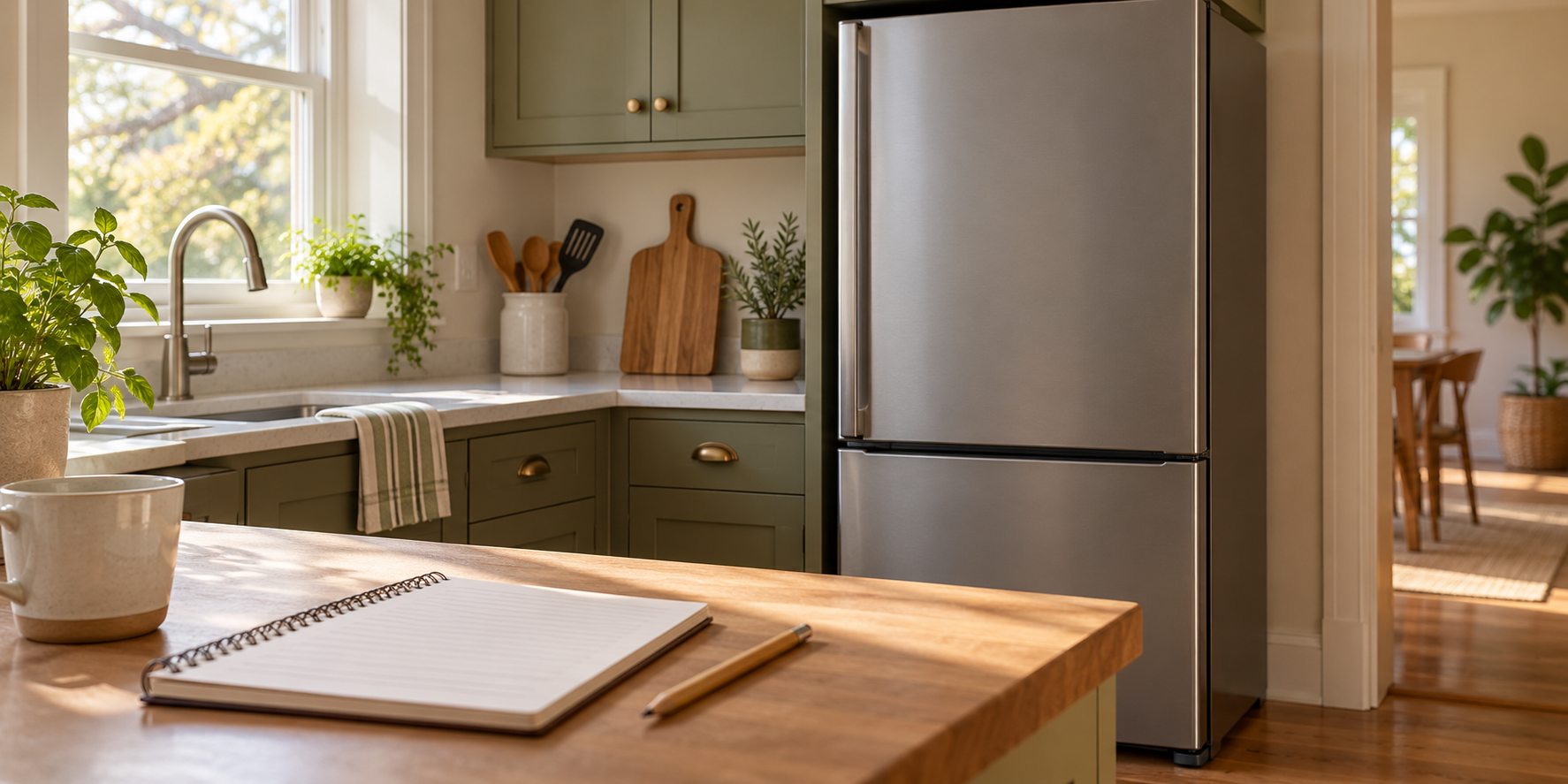
Neutral editorial illustration created with AI: a schematic refrigerator and a time-recording sheet. It does not show the actual contents of an apartment, a temperature measurement or confirmation that food is safe.
The electricity is back, the refrigerator light is on again, and it is tempting to consider the household problem over. Yet restoring power and deciding what to do with food are two separate tasks. A homeowner can usefully arrange how information will be passed on in advance: who noticed the outage, what is known about its timing and who will decide about the contents. This matters particularly when the apartment has been empty, occupants have changed or the owner is far away.
Neither the appearance of food nor tidy packaging replaces an understanding of storage conditions. This article does not assess individual products remotely or give permission to eat them based on a photograph. It helps collect facts and prevent important information from being lost between people. It is not a guide to repairing a refrigerator, choosing an energy-efficient model or disputing an electricity bill.
What AESAN actually recommends
AESAN's guidance dated 29 April 2025, read on 29 October 2026, provides the following pointers. Each product must be assessed separately; never taste it to check its safety or rely on smell or appearance. The time guidance assumes that efforts were made not to open the doors during the outage. If the outage lasts less than four hours, a refrigerator may keep food below 5 °C; the source uses conditional wording, not a guarantee. For an outage lasting more than four hours, AESAN recommends discarding perishable foods: meat, poultry, fish, eggs, milk, fresh cheese and cooked leftovers; cooking does not necessarily remove the danger of improper storage. Cut fruit, vegetables and prepared salads should also be discarded in this situation. Separate conditions apply to the freezer; if it is unclear how long food has been thawed, it should be discarded, particularly if it is no longer cold.
This brief account is not blanket permission for a case whose circumstances are unknown. Read the complete guidance in relation to your own information. We do not invent a rule for exactly four hours or extend the refrigerator guidance to every item in a freezer. If the facts do not allow a recommendation to be applied confidently, do not settle the issue by tasting or guessing.
Record what is known about the event
Start with a short note: when power was definitely available, when its absence was noticed and when restoration was confirmed. Do not replace these different events with a single approximate statement such as “the power went off in the morning”. If someone arrived home after the outage began, their arrival time does not establish its beginning. Mark the unknown part of the period as unknown rather than choosing a convenient figure.
Keep the source of each piece of information. It may be a message from an occupant, a notice from a service organisation or your own record. The publication time of a general neighbourhood news report does not necessarily match the situation in a particular apartment. Do not assemble scattered messages into a precise timeline unless their connection is confirmed. Acknowledging missing information is more useful for a food decision than a neat but invented calculation.
Separately note what is known about use of the refrigerator during this period. Do not blame people for opening the door or ask them to reconstruct every action with false precision. Simply retain the available facts. If circumstances differ from the assumptions in the official guidance, that matters when considering its applicability. The household note should help an assessment, not justify a decision already desired.
Do not confuse a current reading with storage history
If a number appears on the display after power returns, first consult the appliance instructions to find out what it means. It may be a setting or another indication that cannot, without checking, be treated as a documented temperature history of the food. Do not invent capabilities based on the display's appearance. If saved measurements or a log are available, state how and when they were obtained and which compartment they concern.
Keep the model's instructions separate from information about the food. The manual helps explain how the equipment works, but does not say what happened to every package while you were away. Conversely, a food list does not answer the technical question of why an appliance is not cooling. The subjects are connected, but require different information sources and different people to address them.
If you doubt that the equipment is working properly, contact an appropriate professional. Do not dismantle the appliance or perform electrical tests to speed up a household check. A repair report describes the equipment's operation within its stated scope; it does not automatically confirm that all contents were fit to eat before the repair. Do not add a conclusion the technician did not make.
Make a clear inventory of the contents
If deciding about food requires sorting through it, describe items so that another adult can understand them: name, storage compartment, whether packaging is open or closed, and known preparation or purchase details. The list does not need unnecessary personal information or a family's entire eating history. Its purpose is to avoid overlooking individual items or mixing up different storage circumstances.
Do not label an entire drawer simply “frozen food” when its contents and histories differ. A homemade portion without a date and a manufacturer's packaging with legible instructions are different cases in terms of available information. Do not compensate for a missing label by assuming the food was put there recently. If ownership or origin is unknown, ask whoever left it rather than constructing an answer from a memory of a similar container.
A photograph can help preserve a product's name and labelling, but does not replace information about time and conditions. Do not ask an estate agent, cleaner or neighbour to confirm food safety from a photograph alone. Do not use an editorial illustration as an example of a product's “correct condition”. The decision should not depend on how appetising it looks on a screen.
Agree who reports facts and who closes the task
In a family or temporary accommodation, it helps to identify one person to collect information so that several participants do not reach different conclusions from different messages. This does not appoint a household food-safety expert. Their role is to preserve facts, the official recommendation link and a clear resolution of outstanding questions, without replacing competent advice.
If the owner is far away, agree in advance on the limits of the assignment for the person who has access to the apartment. Do not simply ask them to “check that everything is fine”: that encourages an answer based on appearances. Questions about confirmed power, available appliance messages and known circumstances are more useful. Do not make a helper responsible for tasting or smelling food to reassure the owner.
Information handover should be complete. If one person has discarded some contents, another should know exactly what was done and which questions remain. Do not leave the vague phrase “fridge checked” when the check only established that its lamp came on. A precise household report can be short: what is known, what action was taken and what remains unconfirmed.
Do not turn missing information into permission to eat
The hardest situation is returning after an absence without knowing whether outages occurred or how long they lasted. Do not fill in the missing history from a story about a neighbouring building or the current state of electrical appliances. If advice on the particular case is needed, prepare an honest account of the unknowns and the information actually available. Do not call an assumption a measurement.
The financial inconvenience is understandable, but a product's price is not evidence of its storage conditions. Do not seek confirmation only for a decision that preserves all the contents. Agree beforehand that the aim is not to minimise discarded packages at any cost, but to apply official recommendations without self-deception. Do not pass doubtful food to other people as a way to avoid the loss.
Do not replace a safety question with a cooking plan. “We'll cook it straight away” should not be the automatic response to unknown circumstances. First consider whether the recommendations you have read apply to the product. This article offers no technique that makes improperly stored food safe and gives no individual medical advice after it has been eaten.
Keep documents if they may be needed later
An owner sometimes needs to explain expenses or pass information to a service organisation. A brief inventory, relevant documents and the times of known events can be retained for this purpose. But gathering evidence should neither delay necessary action nor justify keeping doubtful food until a third party replies. Keep any potential property-related claim separate from the food decision.
Do not assume you will receive compensation merely because the outage affected the neighbourhood. Contract terms, the event's circumstances and required documents must be considered separately. This article does not determine entitlement to payment, the amount of damage or any particular organisation's obligation. A record of actual actions is useful in itself, even if no claim is subsequently made.
Do not unnecessarily publish your address, contract number or photographs of personal documents in group correspondence. For an initial discussion, describing the event and question is usually sufficient. Send full details only to the appropriate recipient through a suitable channel. A well-organised folder of facts helps more than an emotional mass mailing of identical messages to everyone involved in maintaining the home.
What to prepare before the next visit
Make the refrigerator instructions available to adults who use the apartment and save the AESAN guidance link. If records of prepared portions are kept, make them clear: they help reconstruct history, although they do not replace proper storage conditions. Do not create a complicated system that nobody will use; a few clear labels are more helpful than a formal table containing no real information.
Before a long absence, discuss the contents and what to do in a known outage. Whoever looks after the apartment should understand what they are expected to report rather than guess the owner's expectations. Do not promise continuous remote monitoring if no such arrangement exists. Nor should the presence of an app or notification be treated as proof of a continuous record of conditions in every compartment.
After an incident, review only the organisational gaps actually found: a missing manual, an unclear message, no agreed contact or unidentified contents. Do not conclude from a single event that a different model or expensive system must be bought. Technical solutions are evaluated separately; clear information handover is useful with any equipment.
What a completed household check looks like
A good outcome is not described as “cold again”, but as a clear checklist: circumstances recorded, products not lumped into one anonymous group, applicable official guidance read, uncertainty not concealed, and actions communicated to everyone concerned. If a question remains open, an attractive photograph or a confident message cannot close it.
This approach does not guarantee that all food will be preserved through every outage. It helps prevent the event's timing from being lost, equipment operation from being confused with food safety, and an important decision from being passed to someone without the necessary information. For a homeowner, it is a practical part of household organisation, not a reason to conduct experiments at home.
Source and scope of the article
The main source is AESAN: recommendations for food in refrigerators and freezers after a power outage, published on 29 April 2025 and read on 29 October 2026. The numerical guidance above is given only in the context described by the agency; no individual product's safety has been checked. The remaining structure is an editorial framework for recording facts, allocating household tasks and handing over information, not additional storage periods or medical instructions.
The material is for informational purposes only. Check the legal and financial terms of a specific transaction with relevant specialists.
Select real estateDiscuss with Laverna