
Collective solar self-consumption in a community
How to check collective solar self-consumption: coefficients, community decisions, equipment, bills and future costs.
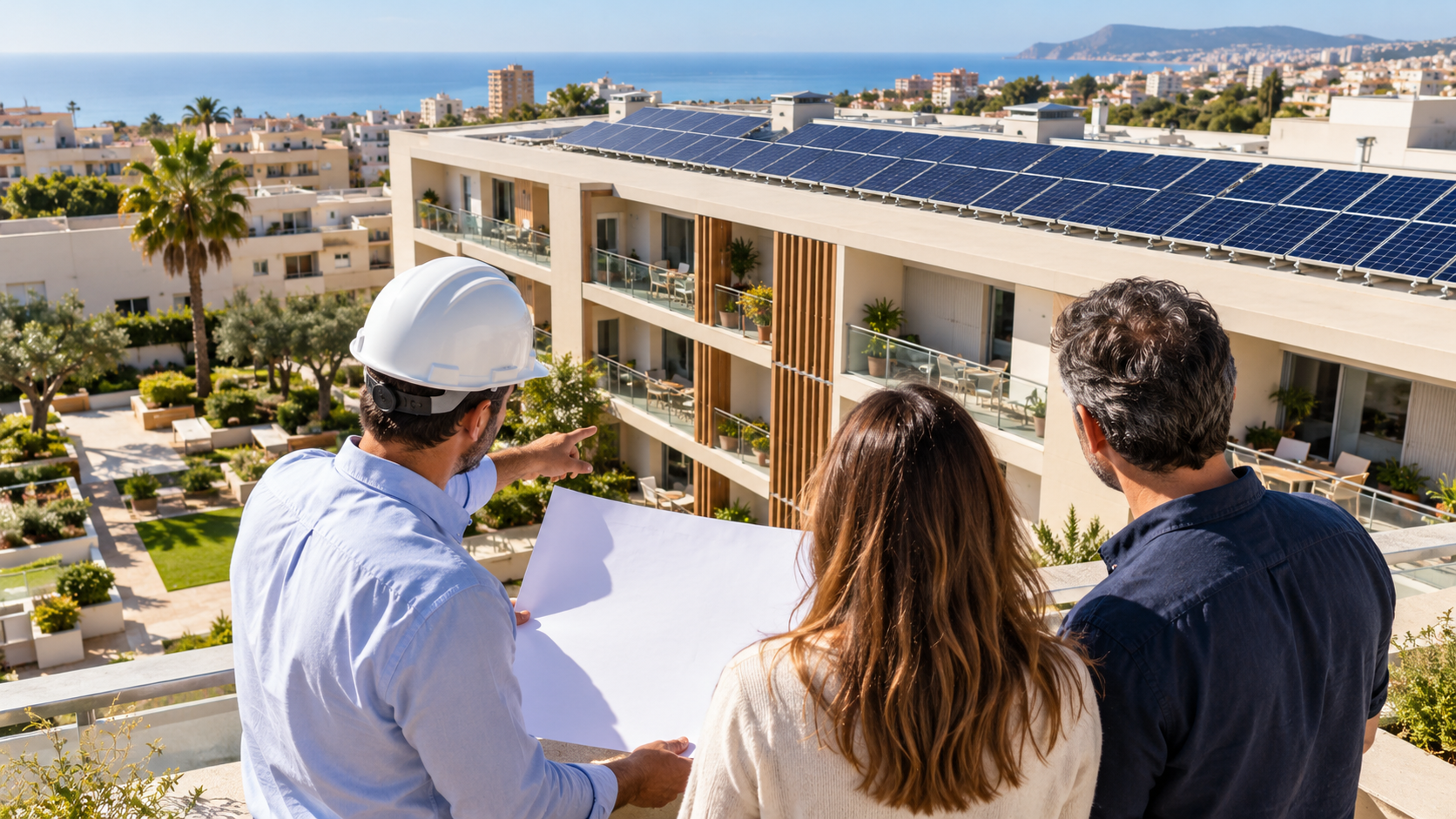
Neutral AI-generated editorial illustration; it does not depict a specific property or guarantee electricity production or savings.
Solar panels on the roof of a residential complex may supply common areas, individual flats or a group of participants. Yet a photograph of panels and the word autoconsumo in a listing do not explain who owns the installation, how energy is allocated or which obligations pass to the buyer. Before buying, compare the technical arrangement, community decisions, contracts and actual bills.
First identify the installation model
In Spain, Royal Decree 244/2019 establishes the administrative, technical and economic framework for self-consumption. It distinguishes arrangements including individual and collective self-consumption and modes with and without surplus energy. The buyer needs the building’s specific registered configuration, not a general label. One system may supply only stair lighting and the pool pump, another may allocate generation among flats, and a third may combine common and private consumption.
Ask for written confirmation of the participating consumption points, ownership of the equipment and parties to the contracts. Do not infer this from panel location: a common roof does not automatically mean common ownership of the installation, while a panel above a particular block does not prove an individual arrangement. Documents establish the participants and use of the energy.
How generation is allocated
In a collective arrangement, energy is not allocated by a subjective view of fairness and not necessarily according to flat area. Agreed allocation coefficients and calculation rules are used. The buyer should request the current agreement, participant list, coefficient for the flat and procedure for changing it. Establish whether the coefficient relates to the particular supply point, how a change of owner is handled and what must be done after completion.
Compare three different measures: total installation generation, energy allocated to the flat and the actual reduction in energy purchased from the grid. They are not equal. Daytime generation may not match the household’s consumption profile. Surplus compensation should not be assumed either: request the applicable mode and contractual electricity-supply terms.
Allocation documents
- the participants’ agreement and current coefficients;
- identification of the supply points and the flat being bought;
- evidence of registration and contracts applicable to the arrangement;
- recent bills with a clear period and occupancy pattern;
- rules for joining, leaving and changing the participant group.
What the community decided
The meeting minutes are needed for more than proof of a vote. They should explain the subject of the decision, budget, financing method, allocation of expenses, contractor and authority of the community representative. Request later minutes as well: the original project may have changed in capacity, scope or timetable. Compare the resolution with the equipment actually installed and the contracts.
Establish separately whether the installation is fully paid. Even an operating system may have an outstanding loan, instalments or future contributions. Request a community debt certificate and documents on special assessments, but do not stop at a general certificate: clarify which obligations relate to the flat and what the parties will agree in the sale contract.
Equipment and access
List panels, inverters, protective devices, meters, monitoring and any batteries. Record manufacturer, model, commissioning date, serial numbers and warranty documents. A component warranty, installation warranty and expected service life are different concepts. Check warranty transfer to the new owner and maintenance requirements.
Clarify who may access the roof and technical rooms, who receives fault alerts and who may call the contractor. An attractive monitoring app does not replace an operator responsible for the system. Ask to see data for a meaningful period and compare downtime with the works log. One sunny day does not describe annual performance.
The roof remains part of the building
Panels cannot be considered separately from waterproofing, fixings and drainage. Request the project, records of completed works and documents confirming compatibility with the roof. During inspection, a professional should assess walkways, fixing points, cable routes and the ability to perform maintenance without damaging common elements. The buyer need not make a technical diagnosis, but should include unresolved questions in the price and timetable decision.
Find out how future roof repairs and panel removal are coordinated. Who pays for removal, storage and reinstallation? Is there a reserve for this work? If the roof already needs repair, current generation does not remove the future expense. Minutes and quotations show how the energy project relates to the building’s overall maintenance plan.
How to read the bills
Request anonymised bills from before and after commissioning, but compare them carefully. A tariff change, number of occupants, air-conditioning use or periods of absence can affect cost more than generation itself. Separate consumption in kWh, allocated solar energy, grid energy, fixed charges and monetary surplus compensation where applicable.
Do not apply the seller’s savings to your own scenario. A household at home during the day, a seasonal owner and someone working away use the same installation differently. Build your own hourly profile for major loads: hot water, air conditioning, vehicle charging, pool and appliances. Ask a specialist to assess future outcomes without guaranteeing fixed savings.
Costs often missed
- scheduled maintenance, cleaning and diagnostics;
- replacement of an inverter or communications equipment;
- insurance and possible policy exclusions;
- roof access and safety measures;
- contract changes when ownership changes;
- removal during common-roof repairs.
An indicative payback calculation should not replace due diligence. Even if the seller shows one, request the underlying energy prices, generation forecast, work costs and allowance for future replacements. Tariffs and consumption change, so several scenarios are more appropriate; comfort and reduced grid dependence should be considered separately from any promised return.
Checks before paying a deposit
- Identify the self-consumption model and use of the energy.
- Obtain the participants’ agreement and flat coefficient.
- Compare community resolutions, budgets and installed equipment.
- Check project payment, debts and future contributions.
- Review contracts, registration, warranties and maintenance.
- Compare annual bills with the occupancy pattern.
- Have a technical professional check the roof and cable routes.
- Record transfer of documents and access credentials in the contract.
A solar installation can be a useful part of a building, but its value depends on a verifiable system, not panels in a photograph. Add separate fields to the property comparison sheet for model, participants, coefficient, obligations, equipment condition and verified billing data.
Sources and verification date
Sources on collective solar self-consumption. Checked on 25 October 2026.
- Self-consumption rules: Royal Decree 244/2019 in the current consolidated BOE version
- Collective self-consumption guidance: official IDAE Guide to collective self-consumption
- Community rules for the solar project: Horizontal Property Act
The applicable procedures, contracts and decisions must be checked for the specific building.
The material is for informational purposes only. Check the legal and financial terms of a specific transaction with relevant specialists.
Select real estateDiscuss with Laverna