
Medicines in a coastal apartment: organising storage according to the instructions
One set of conditions does not suit every package. Practical organisation for a homeowner: instructions, a clear location, privacy and precise questions when conditions are unknown.
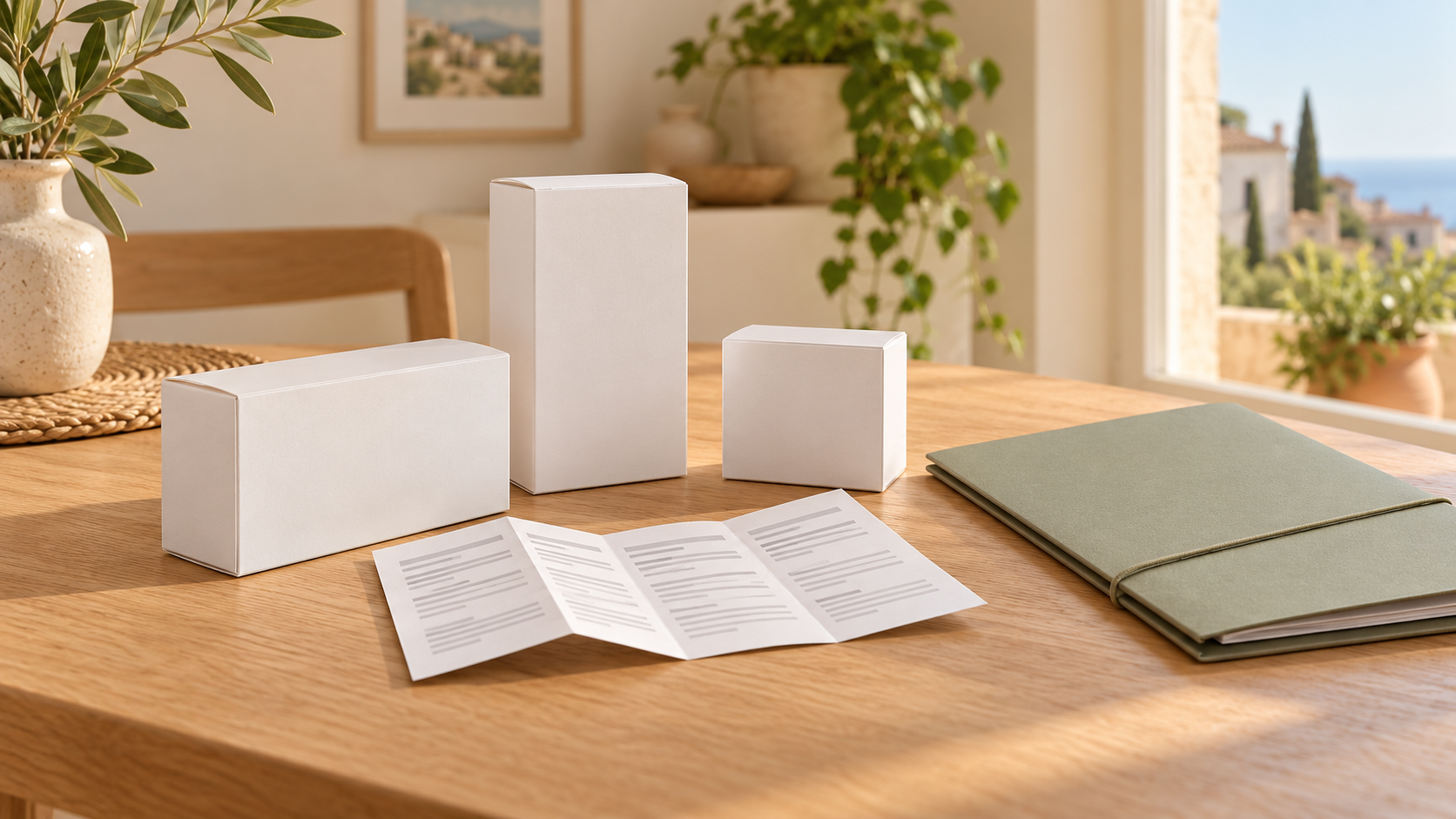
Neutral editorial AI illustration of organised home storage: generic closed packages without medicine names and an instruction sheet. This is not an image of an actual medicine or a treatment plan.
An owner of a coastal apartment may face a simple household question: where and how should medicines be stored if the home is not used continuously, relatives visit or the indoor temperature changes? The wrong answer is to assign the same conditions to every package based on general advice. It is more useful to connect each specific medicine to its own leaflet and decide in advance whom to ask when something is uncertain.
This article concerns organising information and household tasks, not choosing treatment. It does not recommend medicines, doses, replacement products or stopping medication. It does not determine whether a package remains suitable after overheating, a power cut or a breach of storage conditions. If the issue affects ongoing treatment, discuss it with a healthcare professional rather than deciding on the basis of a general article about an apartment.
What the AEMPS material reviewed confirms
In “Medicamentos y calor”, updated on 11 July 2025, AEMPS recommends reading the leaflet carefully: it states the storage conditions. Special temperature requirements are indicated on the packaging. The agency also emphasises that changes to ongoing treatment should be discussed with a healthcare professional, and that routinely reducing or stopping medication on your own because of hot weather is not the starting solution.
The source discusses different categories of storage conditions. This does not justify choosing a single temperature for all medicines at home or treating any package as suitable after an unknown exposure. Below, we do not apply general examples of temperature resilience to a specific medicine. The remaining sections are an editorial approach to checking information, preparing a storage location and seeking clarification, not a medical opinion.
Start with the exact name and the specific package
For a medicine whose conditions need clarification, find its own package and leaflet. A similar name, a familiar box colour or a memory of an earlier purchase cannot replace a match to the specific medicine and formulation. Do not copy conditions from another family member's package merely because the medicines seem similar. If identification is uncertain, prepare a question for the pharmacist.
A working note only needs the name on the packaging, the formulation, the source of the instructions and the unresolved question. Do not turn it into a public list of residents' illnesses. Treatment details, personal data and prescription photographs do not belong in the building's shared chat. If someone needs help reading, agree what information may be given to the helper and who the answer is intended for.
Do not separate storage information from the package so completely that it later becomes unclear what the note concerns. A sheet saying “keep in a cool place” without a name or source is easily confused. Preserve the link between the particular package and the instruction you read. A household note should help locate the original instructions, not become a homemade replacement for them.
Read all the conditions, not just one familiar word
Find the storage section in the leaflet and read it in full. If it specifies a special condition, do not replace it with your own everyday interpretation. “In a refrigerator”, “at room temperature” and “away from heat” cannot be treated as interchangeable without checking the particular wording. This article sets no universal location or temperature for every formulation.
If the leaflet gives different instructions before and after opening or preparing the medicine, do not merge them into one rule. Note which stage applies to your package and clarify it with a pharmacist if uncertain. Do not invent a period after opening or borrow one from another medicine. Also distinguish the date on the packaging from a household record of an event: they are not necessarily the same indicator.
If language is a difficulty, do not rely solely on a brief machine translation of one isolated word. Keep the original wording and ask for a competent explanation relating to this package. Do not round numbers, remove negatives or turn a conditional phrase into a categorical statement. If the meaning remains unclear, an honest “clarify” note is safer than a confident account from memory.
Match the requirements to the actual place in the apartment
After reading the instructions, assess what is known about the proposed storage location and what you are merely assuming. A convenient shelf does not confirm compliance, and a cool feeling to the touch is not a check of a medicine's suitability. If you cannot establish whether the location meets the specific requirements, discuss the choice with a pharmacist, describing the conditions as precisely as they are known.
Do not assume that a place chosen once is suitable through every change in the home. Moving, rearranging furniture, a long absence and a change in a room's use may call for a fresh check of the organisational arrangement. This does not mean testing the medicine yourself. What is being checked is the clarity of the conditions and access to explanation, not the quality of the contents through household methods.
Do not put personal medical information on a shared sign beside the storage location. If several people use the same area, agree how to avoid confusing who owns the packages and whom to ask questions. Helping a person does not require revealing their diagnosis or full treatment plan to every resident. The arrangement should respect clarity, privacy and the restrictions of the particular medicine.
A refrigeration requirement is a separate issue, not a universal improvement
If the specific package and leaflet require refrigerated storage, clarify the appropriate procedure with a pharmacist before putting it there. Do not draw the reverse conclusion that a refrigerator is better for every medicine. A general wish to “keep it more safely” does not replace the manufacturer's instructions or permit changing the conditions at your own discretion.
Think ahead about who will notice a problem with the chosen equipment and how professional clarification will be obtained. Do not promise that a shared display automatically confirms the conditions experienced by every package over time. If there was a power cut or the duration of a deviation is unknown, record the known facts without inventing time and temperature. A particular medicine's suitability should not be decided by a universal household threshold taken from another article.
Do not try to “correct” an unknown exposure through rapid chilling, freezing or another experiment. Do not taste the medicine or use its appearance as proof that quality has been preserved. For your question to a professional, prepare the exact name, the conditions actually observed and what remains unknown. This allows discussion of the specific situation rather than an abstract box of medicines.
Prepare the home for the owner's absence
If the apartment is used seasonally, before leaving review the organisation of the packages remaining there, not the treatment. Who is allowed to move them? Where is the leaflet? Who can contact the responsible person if a question arises? Do not ask an occasional helper to decide suitability or alter a dosing schedule merely because they hold the apartment keys.
Do not leave a helper with the ambiguous instruction “check everything”. Clarify which observations they may report and which actions they should not take. For example, a discovered problem with the storage location can be reported to the owner without opening a package, mixing contents or choosing a replacement independently. The limits of the task should be clear before a difficulty arises.
If it is unclear how the specified conditions can be maintained during an absence, discuss this with a pharmacist beforehand. Do not regard the usual room as guaranteed suitable merely because no problems were noticed before. At the same time, this article does not suggest buying equipment, changing treatment or transporting medicines in a particular way without checking their own requirements.
When relatives arrive, do not automatically combine everything into one shared medicine box
A guest may have their own medicines and individual prescriptions. Suggest that they clarify the necessary conditions in advance and agree on a location without requiring unnecessary medical information. Do not move their packages into a communal box without consent or discard leaflets to tidy a shelf. Products that look similar cannot be considered interchangeable on an everyday visual basis.
If someone needs help organising things, separate that help from treatment decisions. You can help find a leaflet, formulate a question for the pharmacist and keep the answer for the person concerned. A convenient family list must not become a self-made prescription or advice to reduce a dose in hot weather. A household helper handles the agreed organisation, not the medical decision.
In shared accommodation, it is useful to agree who will check the ownership of packages left behind after departure. Do not pass them to someone else simply because that person recognises the name. Do not post pictures with names and prescriptions in the communal chat to find the owner. Contact the presumed owner privately and obtain appropriate professional guidance if there are questions about further handling.
If storage conditions may have been breached, gather facts for the question
Record exactly what is known: which package was affected, where it was, what event was discovered and when. If the start of the event is unknown, say so. Do not replace missing data with the convenient estimate “not for long”, or apply an outdoor weather forecast temperature to the place where the medicine was kept. It is useful to separate direct observation from assumption.
Put a specific question to the professional: what additional information is needed to decide about this package, and how should you proceed within the prescribed treatment? Do not ask for a general answer that “all medicines are safe after heat”. If treatment is ongoing, separately explain that the issue affects availability for the next scheduled intake; do not independently change the prescription while waiting for an answer to a household storage question.
Keep the explanation received, noting which package and circumstances it applies to. Do not circulate an individual answer as a universal rule for other medicines or a different exposure duration. If new circumstances later emerge, return to the professional with that clarification rather than treating the earlier answer as valid under every set of facts.
A short storage record without medical conclusions
A useful household record answers these questions: which medicine is meant, where are the original instructions, which condition must be met, who can clarify it and when were the details checked? It should not contain a homemade assessment of “definitely suitable” unless this has been properly established for the specific situation. Do not replace a professional answer with your own colour-coded safety label.
Check that the record remains current when there is a new package, a change of medicine or a different storage location. Do not automatically copy the old note if the name seems familiar. If a doctor or pharmacist gives new guidance, keep it separate from the previous explanation and do not leave contradictory notes in shared use without clarification.
The main result of this preparation is not a large household stock or a promise to withstand every condition. It is the ability to find the right instructions quickly, avoid mixing up packages, report facts and obtain help with a particular question. Organising the home can support prescribed treatment, but it does not replace it or turn the apartment owner into an expert on the suitability of medicines.
Source and limits of the review
On 30 October 2026, the following was read: the official AEMPS material “Medicamentos y calor”, with a stated update date of 11 July 2025. Only limited provisions on the leaflet, special storage conditions and consulting a healthcare professional about treatment changes were used. Clinical recommendations for professionals and general examples of temperature resilience are not presented here as permissions for household use. No specific medicines or their storage conditions in a particular apartment were checked.
The material is for informational purposes only. Check the legal and financial terms of a specific transaction with relevant specialists.
Select real estateDiscuss with Laverna