
Libro del Edificio after purchase: operational documents, not just a folder
The keys are yours, but instructions and maintenance history are scattered. Separate your apartment folder from the building archive, identify the custodian and request missing information precisely.
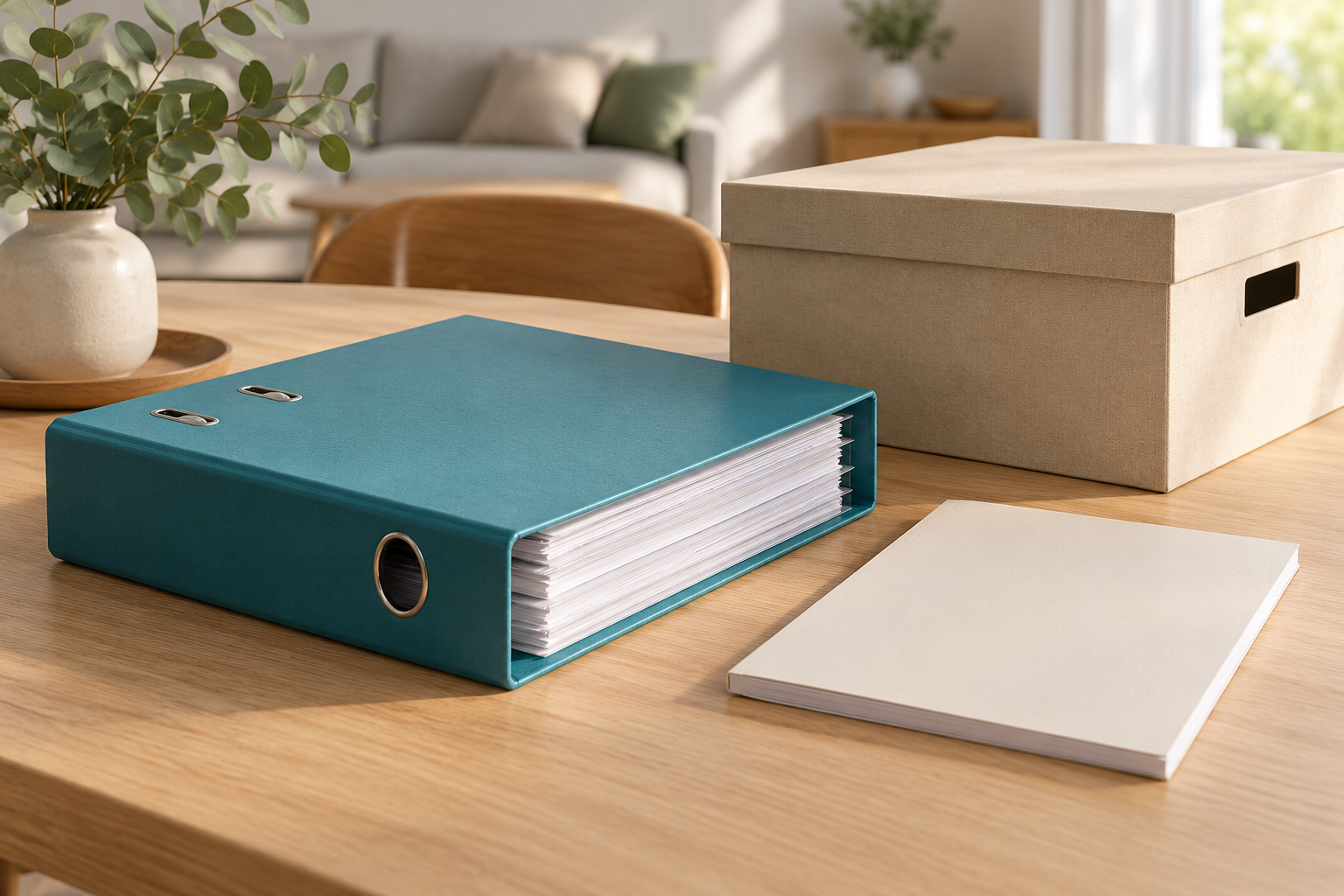
Editorial AI-generated illustration: a turquoise document folder, a closed archive box and an unlabelled booklet on a wooden table. This is an illustrative scene, not a photograph of the property for sale.
After buying an apartment in Alicante, the owner receives keys, a few appliance instructions and a link to the manager’s folder. But where is information about communal installations, which documents relate to the apartment itself, and what should maintenance planning be based on? The useful task is not simply to collect a large archive but to understand the Libro del Edificio and the individual carpeta de la vivienda: who keeps them, what they contain and what information is missing for normal use of the home.
This article concerns handing operational information to the owner. It is not a technical inspection, an opinion on the building’s legality or a guide to registering a new building. Applicability to an individual building depends on its history and works, which relevant professionals must assess. A folder with the right name alone proves neither that equipment works correctly nor that maintenance has been carried out.
Do not confuse the apartment folder with whole-building documentation
Article 7 of Ley 38/1999 connects the Libro del Edificio to documentation of the completed building: the design with approved modifications, acceptance record, details of construction participants and instructions for use and maintenance. Article 16 separately provides for owners to receive, preserve and pass on documentation. This is broader than a promotional floor plan or a set of household-appliance manuals.
The Valencian Decreto 25/2011 distinguishes the building book from the folder for an individual dwelling or unit. Where that regime applies, the folder concerns the relevant part of the building and the book is handed to the comunidad; custody, updating and consultation by owners are provided for. A buyer not holding the entire communal archive should therefore not automatically be equated with all documentation being absent, but the relevant custodian and access must be established.
Start with two separate questions for the seller and manager: “What is handed to me for the apartment?” and “Who maintains the building’s shared documentation?” Ask not just for one link bearing the complex’s name, but for an index of available sections and a responsible contact. In a multiphase development, clarify which block, garage and communal installations each package covers. A neighbouring block’s similar name does not establish that its instructions apply.
Building history matters more than a simple construction-year rule
An older house, a new block and a partly reconstructed building may have different starting documents. Decreto 25/2011 has its own scope and transitional provisions, but a single date cannot establish a universal exemption from other requirements. Ask a professional to connect the history of the licence, completion and later interventions to the obligations applicable to your particular property.
This is not an abstract caveat for the Costa Blanca. In a decision concerning Benissa published in July 2026, the Dirección General de Seguridad Jurídica y Fe Pública rejected the argument that a licence predating Decreto 25/2011 by itself excluded the building-book requirement. That case considered different grounds for preparing documentation and depositing it with the registry. It does not decide your apartment’s position, but shows why “the building predates that decree, so nothing is needed” is insufficient.
For your enquiry, prepare a short chronology from confirmed information: construction, known reconstruction, major-installation replacements and document handover. Do not try to reconstruct a technical design from photographs. Mark unknown dates or work scope as unknown. The owner’s task at this stage is to obtain a clear route to a professional and the missing document, not personally declare the building compliant with every rule.
Check that the instructions relate to what is actually installed
A folder may contain a manual for a similar boiler, an old ventilation system or equipment already replaced. Before creating a maintenance calendar, compare available designations with the actual installations. Do this without opening electrical panels, climbing onto the roof or taking other risks: a professional or maintenance company should check where necessary. A model mismatch is a question to clarify, not a reason to select settings from an approximately similar manual.
Divide material into three groups: communal building installations, apartment equipment and household devices outside the building’s technical documentation. For each, record who explains operating arrangements. A question about a communal pump cannot automatically be assigned to the refrigerator seller, for example, and an appliance warranty does not replace information about installation work. This distinction helps direct questions to someone able to answer.
If an instruction exists only through an old link, ask whether an accessible copy can be obtained and retained. Check that the file opens and concerns the required equipment version. Do not replace official documentation with your own retelling: a brief owner’s note can help, but should lead to the original manual and agreed instructions rather than become a new technical manual.
Separate the maintenance plan from evidence of completed work
A table of future dates shows intention, not completed maintenance. The applicable Valencian regime provides for a programme, recording operations performed and updating documentation during the building’s life. For an owner, the practical question is how the next task, actual contractor and result document connect, not merely whether an attractive calendar exists.
Ask for the statuses used to be explained: planned, ordered, completed, repeat check required. If the log says “done”, ask which document supports it and which equipment it concerns. An invoice for a professional’s visit does not always explain the operation performed; where unclear, request the relevant record or report through the responsible person. Do not call the result poor simply because the format is unfamiliar: first establish what this system records.
Do not copy intervals from an article, neighbouring building or generic app into your calendar. Necessary operations and timing follow applicable requirements, equipment documentation and professional instructions. No common interval for every façade, lift, pump or air-conditioning system is proposed here. Keep a reference to the basis of each task so the calendar can be revised sensibly when equipment changes.
Understand the boundary between owner actions and professional work
A convenient checklist should not turn the buyer into a technical contractor. For each operation, ask who is authorised and competent to perform it: user, maintenance organisation or relevant professional. If instructions are unclear or involve communal equipment, clarify arrangements with the manager first. Do not switch off a shared system or change settings merely because the item appeared on your personal task list.
Mark separately what concerns the private apartment and what requires a comunidad decision or organisation. Having maintenance instructions is not permission to alter a communal component yourself. If a repair needs approvals, a technical design or an administrative procedure, those questions are addressed separately. Documentation prepares the discussion but does not replace necessary powers and permissions.
For an owner who visits the Costa Blanca only part of the year, agreeing contractor access and report delivery beforehand is useful. This is an organisational arrangement, not a basis for giving someone unlimited powers or a private-account password. Name a problem contact and an approval process for extra work; absence must not become automatic consent to any expense.
Make a targeted gap list rather than demand “send everything”
A request is clearer when it identifies the missing item: instructions for the installed model, information about a completed replacement, the shared book’s custodian or confirmation that the apartment folder is accessible. Explain the action it supports, such as arranging maintenance after purchase. Do not send the whole archive indiscriminately: technical material may include information about people, access and building organisation.
Keep four fields in your own list: what is missing, whom you are asking, why it is needed and the answer received. If the seller says the manager holds a document, that does not yet mean the manager has found it. Close the question after actual receipt or a clear professional explanation of the next route, not simply after another contact is forwarded.
A missing document does not give the owner a ready legal conclusion about whether a sale is possible or who is responsible. If the gap affects safe operation, repair planning or the transaction, refer it with known facts to a competent professional. Do not create a retrospective record of work performed just to make the archive look complete.
Preserve the link between changes and new documentation
After equipment replacement or an agreed repair, ask which materials should supplement the existing package and who supplies them to the custodian. In your own folder, keep the change description, date, responsible contractor and documents received. An owner’s entry is not a technical opinion and does not replace a document a professional must issue.
For a later sale, it is useful to hand over not just the original folder but a clear list of subsequent apartment-related documents. Coordinate communal material with the comunidad’s custodian. Do not promise the buyer that a collection of files proves the absence of every hidden defect: documentation and actual technical condition require different checks.
A good post-purchase outcome is understanding where documentation is, which installations it covers, who maintains the communal part and which questions remain open. There is no need to turn a home folder into a complex system. The important thing is for maintenance or repairs to start from applicable information rather than a renewed search for an unknown manual in old correspondence.
Sources and scope of verification
On 31 October 2026, Articles 7 and 16 of Ley 38/1999on documentation and owners were read, together with the relevant sections of Decreto 25/2011 in the official Housing Legislation Code of the Comunitat Valenciana, including scope, handover and maintenance of the book. Also read was the DGSJFP decision of 25 March 2026 concerning Benissa. Consolidated compilations are informative; application to a particular building must be checked separately.
The proposed organisation of enquiries and a home list consists of editorial recommendations, not a technical maintenance programme. No particular complex’s documents, installation condition or manager’s performance were checked. Nor should this operational documentation be confused with the separate technical study Libro del Edificio Existente for a rehabilitation or aid programme: clarify the purpose of the document being commissioned separately.
The material is for informational purposes only. Check the legal and financial terms of a specific transaction with relevant specialists.
Select real estateDiscuss with Laverna