
Buying a protected home: is essential renovation compatible with its protection?
A general answer about a home's protection does not tell you whether your essential renovation is possible. Arrange checks of specific elements, options and the administrative route before the transaction.
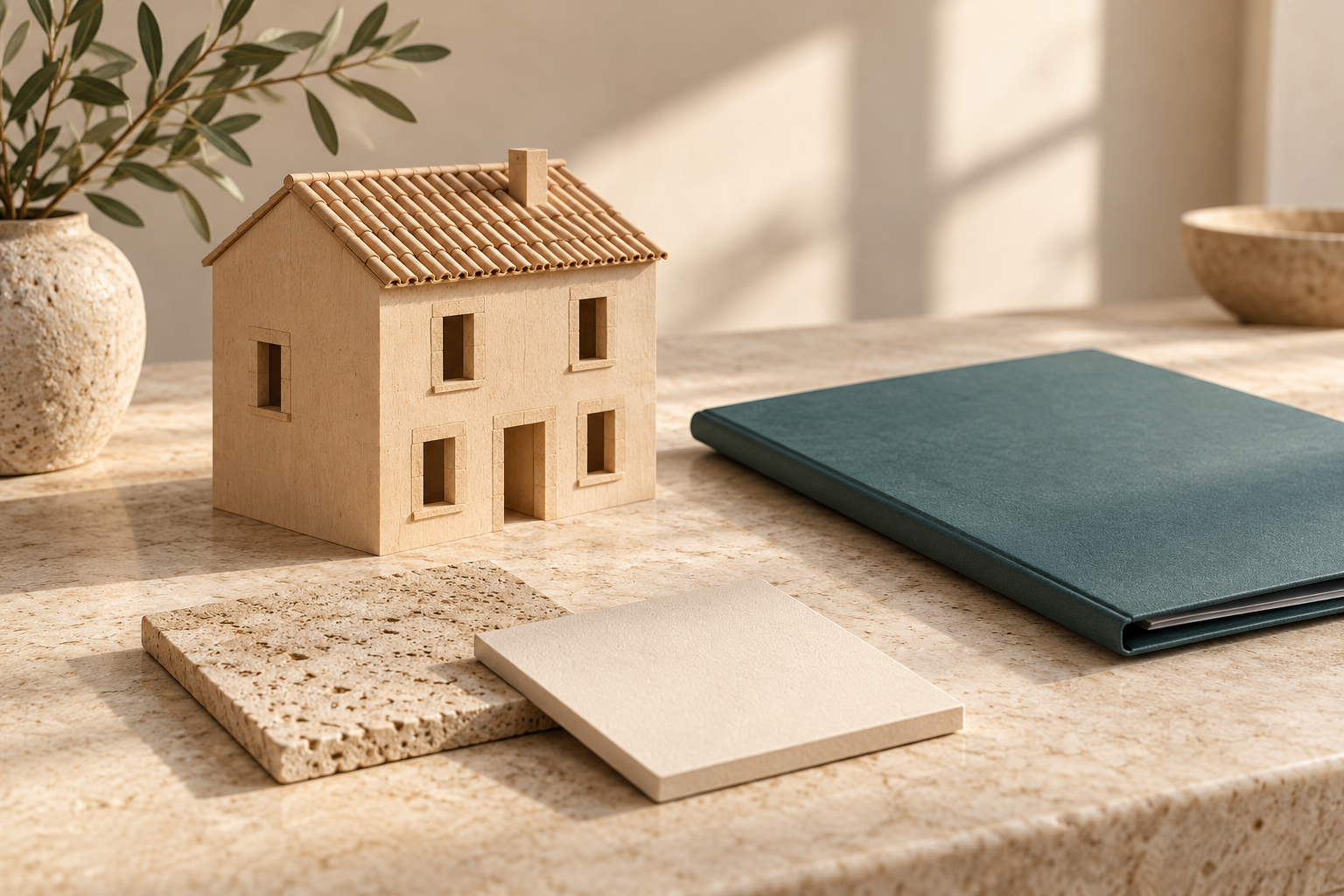
AI-generated editorial illustration: a wooden house model, a closed turquoise folder and two material samples on a light-coloured table. This is a symbolic scene, not a property photograph or an approved renovation design.
A buyer likes an old house on the Costa Blanca but can only live there after specific work: replacing windows, altering the entrance or installing equipment. In that situation, “Is the house protected?” is too broad a question. Before buying, match the particular change you need against what is protected and establish the applicable approval process. An attractive façade and price do not answer that question.
Below is a way to prepare a focused brief for an architect and lawyer for a home in the Comunitat Valenciana. It is not an assessment of a particular building or an instruction to start work. We do not establish the current status of the Alicante or any other municipal catalogue, identify a property's protection from a photograph or promise permission. The practical aim is to understand whether the renovation essential to you is compatible with the proposed purchase.
Start with the change without which the purchase loses its purpose
Write a short description of how you intend to use the house. Separate essentials from preferences: entering without an inconvenient staircase may be a fundamental condition, while a particular window colour may be a preference. Calling everything essential makes it hard for a professional to suggest a viable option. Concealing a genuinely important need makes an assessment of minor work useless for the buying decision.
Do not stop at words such as “refresh”, “modernise” or “do what the neighbours did”. Describe exactly what would be removed, replaced, moved or added, and in which part of the building. An external equipment unit involves not just the appliance but its location and routing; an entrance involves not just the door but alterations to the opening. These are design questions, not a claim that such work is universally allowed or prohibited.
Prepare two columns: desired outcome and proposed method. “The room should be more comfortable” does not require you to commit in advance to a single way of altering the façade. If a professional suggests another technical option, you can evaluate it without losing the main goal. But an alternative cannot be called permissible merely because it is less visible from the street.
Status, area and elements are three different questions
Regional law distinguishes Bien de Interés Cultural (BIC), Bien de Relevancia Local (BRL), protected areas and the surroundings of protected assets. For a BRL, the catalogue describes the values, protected elements, protection level and intervention regime. The procedure for a BIC also depends on its category, the work and applicable protection planning. A general protection marker therefore cannot replace reading the documents for the particular property.
Ask the professional to tie the answer to an exact address, identifier and boundary plan. A house may be considered individually or as part of a wider protected area. Zooming into a map is convenient, but an enlarged section without a legend and document title does not explain a line's legal significance. Keep the full document link and relevant sheet so that the conclusion can be traced.
Identify separately the parts of the building affected by your plans. Do not replace this with “We are keeping the façade, so anything is possible inside”. Ask about each affected element and request the text or drawing supporting the answer. Where information is missing, the correct entry is “not yet established”, not “no restrictions”.
Build a compatibility table, not a collection of permissions
Give each essential piece of work a row: existing element, proposed change, protection document, technical option and next answer required. Identify who should check it: the architect assesses the design, while the lawyer considers the transaction implications and the documents received. This table is your working tool, not an official application form.
For example, a hypothetical wish to replace windows must become questions about their existing pattern, material, dimensions and installation method, where relevant to that property. Do not write the same prohibition for every old house in advance. The professional must identify the important characteristics here, and the buyer should not order the product before receiving that answer.
For roof work or changes to access, add photographs of the current condition and a sketch of the desired result. Label the sketch as a proposal for discussion, not an approved design. Do not confuse it with an archive drawing: visually similar files with different purposes can easily create false confidence for the seller, contractor and buyer.
End each row with one of three working statuses: documented confirmation, professional development required, or no answer. Do not turn a lack of objections into confirmation. If the purchase depends on the final row, a general letter saying the building is in a residential zone cannot close it: that answers a different question.
Clarify the application route and each participant's role
The official Generalitat procedure G162 concerns authorisations for interventions in immovable BIC assets and their surroundings in the cases provided for. It requires information about the proposed intervention and supporting documentation. The procedure's existence does not mean every renovation of every old house must use it. A professional must establish its applicability to the particular status and work.
There is also the separate G22920 procedure, intended for local authorities and concerning specified interventions in BRL assets not included in the relevant catalogue. Buyers should not treat it as a universal personal application form. Ask the municipality whether this situation applies to your building, who submits the materials and what response is needed before the next action.
Request a written sequence: who prepares the description of work, who seeks the necessary response and which decision permits the next stage. Do not replace it with several applications sent simultaneously “just in case”. Inconsistent project versions make it harder to understand which proposal was considered at all.
Appoint one custodian for the correspondence. Their folder should distinguish the submitted design, its supplements and the response received. If discussion changes the equipment location or the design of an opening, record the new version. An old response cannot automatically be treated as confirmation of the changed proposal; put that question back to the responsible professional.
An interim document does not mean there is no protection
The law attaches certain protective effects to the public consultation on a catalogue, while regulating final approval and inclusion in the regional inventory separately. “The catalogue is not final yet, so there are no restrictions” is therefore an unsafe conclusion. For your transaction, the professional must identify effective documents and possible interim measures, rather than rely on the name of a PDF found online.
Check that the saved file concerns the right version and area. A consultation page, notice, catalogue sheet and final decision perform different functions. Ask not simply for the file with the newest date, but for an explanation of what it confirms for your address and proposed work. We do not give an unverified final approval date for any municipal catalogue here.
If advisers use different documents, do not automatically choose the more convenient conclusion. Ask them to compare sources and identify whether the status, boundaries or entry's content has changed. Leave that part of the decision open until there is a reconciled answer. This is better than discovering after completion that the estimate relied on a document from another stage.
How to handle the seller's promise that “permission already exists”
Ask to see the full document together with the description or design to which it relates. Then compare the address, stated work, conditions and actual situation. “For renovation” is insufficient: your future proposal may differ from the previous one. Do not conclude that someone else's permission is transferable, valid or sufficient without checking.
Ask your own professional which circumstances require further confirmation before buying. Do not use this article to calculate validity periods yourself: administrative pages may retain outdated wording, so no universal periods are given here. The dates and conditions of the particular document must be compared with the applicable rules.
If the seller shows photographs of completed work, distinguish the visible condition from its documentary basis. A photograph of a beautiful staircase shows its appearance when photographed, but does not replace documentation. Likewise, a similar solution in the next building does not establish that your design is permissible: the original elements and conditions may differ.
Turning the findings into a buying decision
Before discussing the price, put together three scenarios: the desired proposal is confirmed for further development; an acceptable alternative is needed; or an essential condition remains unconfirmed. These are not legal categories or a promise of approval. They help you understand which risk you are prepared to discuss and which you cannot yet assess.
Request an estimate for the specific option considered. Do not compare a cheap estimate for ordinary replacement with a more detailed estimate for preserving particular elements as though they covered the same work. If the technical solution is unresolved, separate an initial estimate from an agreed price and do not present the former as the full renovation budget.
If compatibility of essential work remains unconfirmed, discuss with an independent lawyer how to reflect this in the transaction sequence and documents. Do not copy a universal automatic-refund clause: its meaning depends on the contract and circumstances. This article does not recommend taking on commitments on the assumption that permissions can be obtained later.
A short professional brief before the next viewing
Provide the home's exact identification, a list of essential changes and available protection documents. Ask the professional to establish the affected values and elements, applicable application route, missing starting information and possible technical alternatives. Ask separately for conclusions that remain preliminary to be identified. You are commissioning a check of your future use, not an abstract answer about the house's age.
At the viewing, check whether missing information can be obtained: access to the relevant part of the building, existing drawings and the document custodian's contact details. Do not ask the seller to confirm technical compatibility independently if that is not their professional role. Their help in gathering information is useful, but does not replace an independent assessment.
The final folder should answer one practical question: which change essential to you has been checked, on what basis, and what remains unknown? If the answer consists only of an attractive visualisation of the future renovation, the check is not finished. You can choose a protected home knowingly without promising yourself freedom to make changes that nobody has confirmed.
Sources and scope of verification
This material is prepared as at 31 October 2026 for the Comunitat Valenciana. It uses the current regional law and official descriptions of two administrative procedures; no particular building, project or municipal catalogue was checked. The practical tables and questions above are an editorial way of organising checks, not legally prescribed forms. Individual legal and technical conclusions require a professional.
The material is for informational purposes only. Check the legal and financial terms of a specific transaction with relevant specialists.
Select real estateDiscuss with Laverna