Food stocks at home: use-by and best-before dates
A number alone is not enough: the date wording, package integrity and storage history matter. A practical approach for ordinary household supplies and seasonal homes.
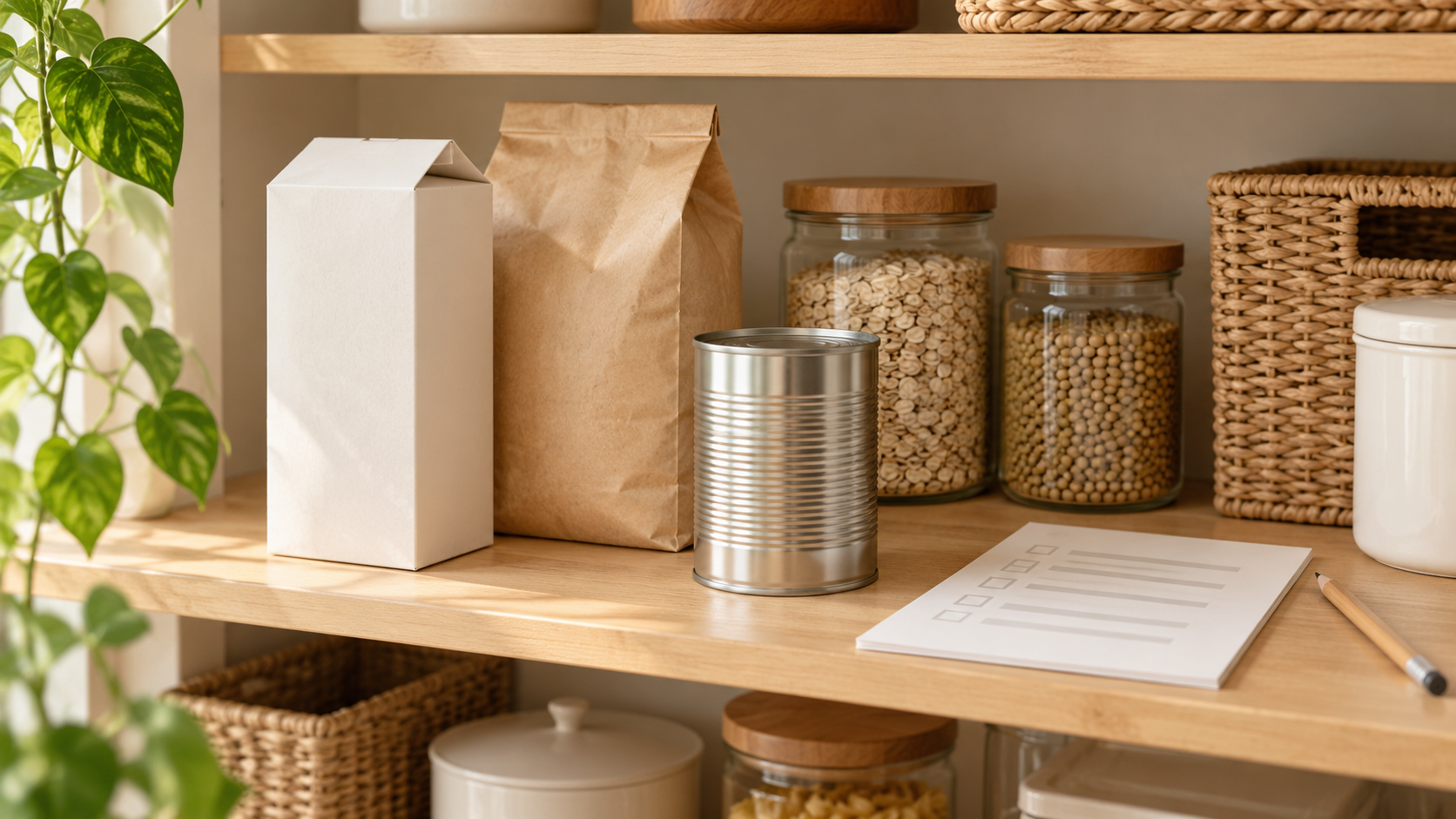
Neutral editorial AI illustration of a household shelf with generic packages and an inventory sheet. It contains no actual product, readable expiry date or assessment of whether food is fit to eat.
In an apartment you do not visit every day, food supplies can easily become a collection of uncertain memories: this package was bought recently, that one probably was not opened, and the date on another is no longer visible. The starting point is not a rule to “throw everything away” or “it is all still edible”, but reading the actual labelling and understanding the conditions it refers to. It is especially important not to confuse two different phrases on Spanish labels.
This article concerns organising ordinary household food stocks, not assessing food after an incident, a refrigerator shutdown or an unknown breach of storage conditions. It does not confirm the safety of any particular package or suggest tasting questionable food. If storage, package integrity or the date is unknown, a confident assumption based on appearance cannot resolve that uncertainty.
Two dates answer different questions
In a statement dated 16 October 2024, AESAN distinguishes fecha de consumo preferente — the date for retaining the product's expected qualities — from fecha de caducidad, after which the food must not be consumed. The agency also reminds readers to follow storage conditions and instructions after opening. These terms should not be reduced to one household word such as “expiry”, losing their different meanings.
AESAN's 2025 leaflet clarifies an important condition for consumo preferente: after that date, a product may remain safe if storage conditions have been followed and the packaging is undamaged, although flavour and texture may deteriorate. This is not permission to ignore damage or an unknown storage history. The leaflet requires following the particular label's directions; its numerical examples do not become general time limits for every food.
What follows is an editorial way to organise reading and household notes. It does not replace the label, add “extra days” or turn a shopping list into a laboratory test. Keep the type of date in your record, not just its numerical value; otherwise, the next time you look, you will not know which rule it concerned.
Look at the whole package before making a note
Find the full phrase beside the date and the indication of where the actual marking appears. Do not draw conclusions from numbers on the bottom of a tin without understanding their purpose. If the wording directs you to another part of the package, look there. A batch code and a date must not merge into a single guess merely because they are printed together.
Do not copy a date from memory based on an online shop's photo of a similar product. For household supplies, the particular package matters. Even a familiar product can carry different labelling from the previous purchase. If the print is illegible, do not reconstruct a missing digit from an assumed storage duration.
Check that your own sticker is not covering part of the original information. A note should make reading easier, not remove the possibility of checking again. If taking a photograph for your personal record, include the product name, the date wording and its associated directions. An image without context may preserve the number but lose its meaning.
Separate unopened packages from food after opening
Read any separate instructions for the opened product. The printed date does not override those conditions. Do not transfer an “after opening” rule from another sauce, drink or brand to the package at hand. A similar appearance does not justify assigning the same time limit.
In a household note, it helps to record the actual opening date in a way that cannot be confused with the manufacturer's marking. If the opening time is unknown, do not assign today's date for the sake of tidy records. “Unknown” honestly identifies the problem; a new sticker does not make the product's history known.
Do not treat returning an opened package to the shelf as a return to “unopened” status. These are separate organisational categories. If another occupant does not know whether the food has been opened, resolve that question before use rather than leaving them to choose between two contradictory notes.
Storage conditions are part of reading, not a separate formality
Compare the label's directions with what is actually known about storage at home. A product requiring particular storage does not become suitable for another shelf simply because that is convenient. This article does not set a universal temperature for all supplies or infer compliance from how a person feels.
If the apartment has stood empty for a long time, separate confirmed information from assumptions. Finding a package in its usual place does not explain its entire storage history. Do not apply the current room temperature to the whole period of absence. If a separate emergency incident occurred, an ordinary date review does not replace assessment of its consequences.
Do not use appearance, smell or a taste test to prove safety when conditions are unknown. Household records help show where information is missing, but do not create it. If reliable labelling and circumstances cannot resolve the issue, do not call the food checked simply to reduce waste.
Make a short list that genuinely helps
For the supplies you select, link the particular product's name, date type and value, package condition and relevant instructions. There is no need to turn a kitchen into a warehouse system with dozens of fields. Start with what is most often confused: similar packages, foods already opened and purchases left until the next visit.
Each entry should have a clear source. If the date was copied from the package, say so; if it still needs to be read, do not enter an invented value. Do not automatically assign “safe” status to every line whose date has not yet arrived. That status conceals damage and storage questions that a calendar mark alone cannot resolve.
Periodically check not the list's size, but whether it matches the shelf. Is the listed food still there? Has it been opened since the last update? Is an empty package still in the records? The practical purpose is to help someone understand the real situation, not prove that every table cell has been filled.
Plan purchases without adding your own suitability periods
Before buying, check what you already have and whether its labelling can be read. This helps avoid duplicate stocks just because the relevant package is difficult to find at home. But reducing unnecessary purchases must not become a promise to eat any food you discover: first you need to understand its condition and circumstances.
If departure is approaching, plan quantities around actual use and the specific instructions. Do not buy more simply because “it can be eaten after the date anyway”, without distinguishing the label type. No additional period may be invented for fecha de caducidad, and storage and package-integrity conditions must not be dropped for consumo preferente.
Freezing must not be treated as a universal way to correct an already-passed date or unknown storage. This article gives no freezing, thawing or subsequent cooking procedure. If considering that approach, consult suitable directions for the particular food and official information, rather than a wish to automatically extend every entry in the list.
A shared kitchen needs clear labelling
Agree with occupants how opening a package is recorded and where the original information remains. There is no need to publicly record personal food preferences or medical information for routine inventory purposes. It is enough for a person to understand what the product is, which date is given and what is known about opening.
Someone rearranging food must not inadvertently deprive others of labels or a clear system. Do not decant or move supplies merely to make the shelf look uniform if the connection with the instructions will be lost. First work out how to retain the necessary information for each particular food.
Do not mix the contents of different packages under one common date. In this editorial approach, the aim is to keep origins and conditions distinguishable, not create the appearance of a single batch. If information has already been lost, a simple sticker with a more convenient date cannot restore it. Mark that issue as unresolved rather than hiding it behind attractive organisation.
Recheck the facts for the next visit
For a seasonal home, a short stock note before departure is useful, but it does not guarantee the condition on return. When you arrive, compare it with the actual package and available storage information. Do not treat an old photo as proof that nothing has changed.
If other people visited the apartment, ask whether food was opened or its storage location changed. You need not collect a detailed log of other people's lives: only information relevant to understanding the particular package. If no answer is available, do not replace it with an assumption that everything remained as before.
When passing food to another person, retain its relevant information and do not promise suitability you cannot confirm. A “to take away” note does not override label conditions. Do not use giving food to guests as a way to dispose of uncertain supplies without telling them about that uncertainty.
How to ask when labelling is unclear
First gather the product name, the exact wording beside the date and a readable image of the relevant part of the package. State whether the food has been opened and what circumstances are known. Do not ask the general question “can it be eaten after expiry?” without distinguishing the date and conditions: it is too vague for a precise answer.
When contacting the manufacturer or seller, use a verified contact and do not add unnecessary personal information. The answer must concern the particular product and original circumstances. Do not extend an individual clarification to other foods merely because their packaging is similar or they share a brand.
When new information arrives, update the household record while preserving exactly what was clarified. Do not change the original date as if the manufacturer had printed a different number. An explanation helps interpret the label but does not authorise rewriting it or creating your own storage period.
Good organisation preserves the meaning of limitations
At the end of the review, four things should be clear: which date type is shown, which package it belongs to, which storage and opening conditions apply, and what you still do not know. This is more useful than simply sorting into “new” and “old”. The age of a purchase does not replace the label, and a tidy kitchen does not confirm every product's safety.
Household organisation helps plan shopping and reduce confusion, but does not guarantee an absence of risk or promise particular savings. Do not add your own extra days to the official meaning of dates, test questionable food by tasting it or treat unknown conditions as confirmed. The aim is to decide using readable information, not find a convenient excuse for every leftover item on the shelf.
Sources and verification date
On 30 October 2026, the following were read: the official AESAN explanation of the two types of dates on food packaging and the text of AESAN's 2025 leaflet on following the label. The complete available indexed text of the leaflet was read; no visual PDF inspection was performed. Limited definitions and conditions were used; numerical cooking and storage examples were not transferred into universal rules. No particular foods or actual conditions in an individual apartment were checked.
The material is for informational purposes only. Check the legal and financial terms of a specific transaction with relevant specialists.
Select real estateDiscuss with Laverna