
Noise maps in Spain: how to check the area and the flat
How to compare a noise map, several viewings, windows, layout and community information before buying a flat in Spain.
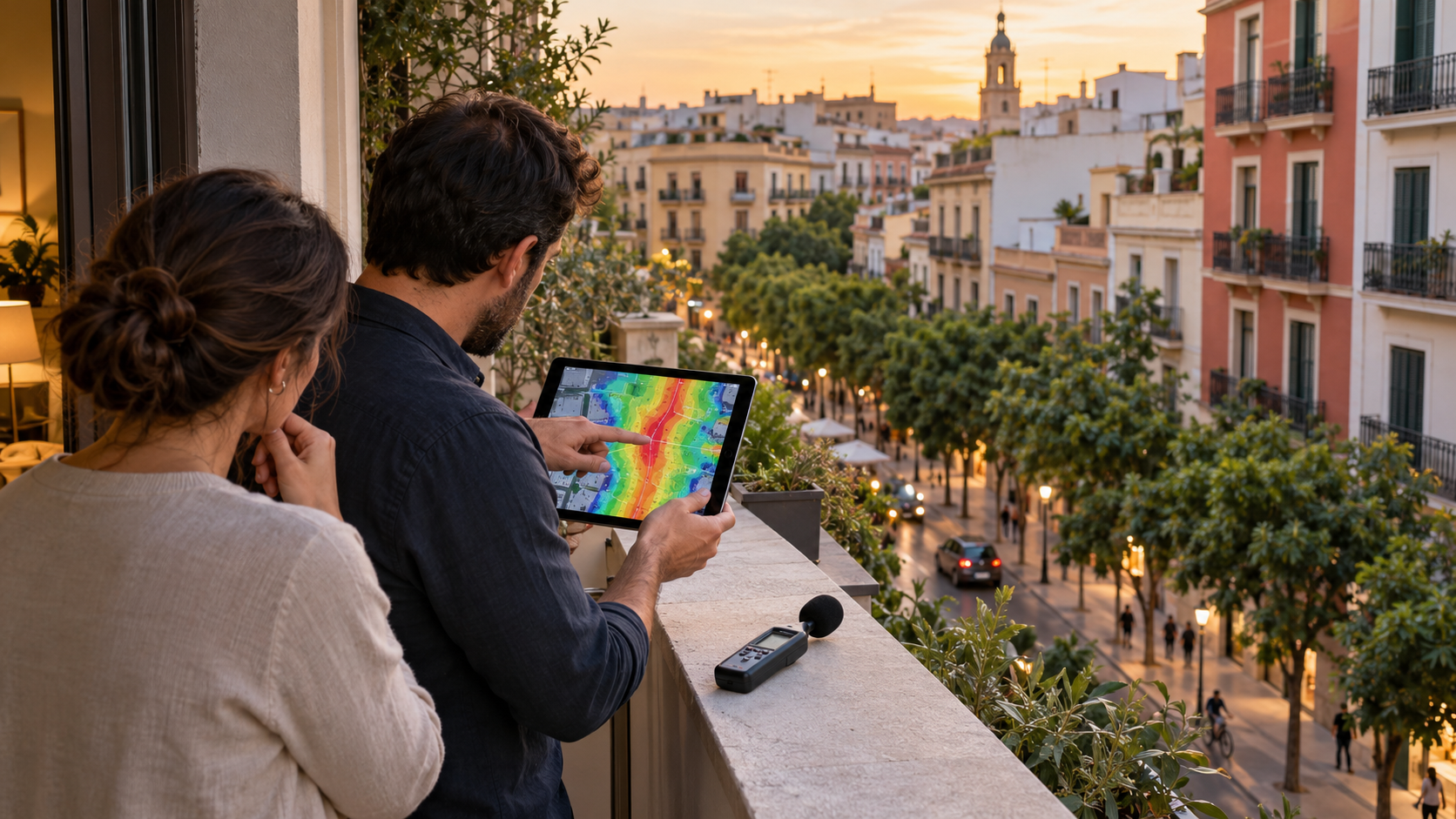
Neutral AI-generated editorial illustration; not a specific property, official noise map or documented measurement.
One quiet viewing does not prove that a flat will be quiet at night, in summer or on a working day. Before buying a home in Spain, it is useful to combine official noise maps, the neighbourhood layout, several visits and an assessment of the building itself. A map models the wider area, while the comfort of a particular bedroom also depends on the façade, windows, floor and how nearby premises are used.
What strategic noise maps provide
Ley 37/2003 del Ruido establishes the general system for assessing and managing noise, including maps and action plans. These materials help identify major sources such as roads, railways, airports, ports or activity areas. They are suitable for an initial comparison of neighbourhoods and for formulating questions to the municipality, but they are not a measurement inside the flat being purchased.
Check the map title, the year of the data, the type of indicator and the source. Day, evening and night periods may be represented by different indices. A colour legend without units and a time period is not useful. Save the link and an image of the relevant area with the date checked, because infrastructure and models are updated.
Why the address alone is not enough
Two flats in the same building may feel very different. One may face the road and the other a courtyard; the bedroom may be on the sheltered side while the living room is above commercial premises. The floor, balcony slabs, neighbouring buildings and terrain alter how sound propagates. The neighbourhood map therefore provides context, but the decision must be based on the particular layout.
Mark every window and the permanent surrounding sources on the floor plan: traffic, stops, play areas, a garage exit, deliveries, ventilation equipment, bars and the development’s common areas. Distinguish a regular source from an isolated event. One loud motorcycle does not characterise the average background, but regular early-morning deliveries require a separate check.
Conduct viewings at different times
- a weekday during busy traffic hours;
- an evening when venues are open and neighbours return home;
- a weekend if the area is tourist-oriented or family-oriented;
- the time of cleaning, refuse collection or deliveries;
- the operating period of the pool and common recreation areas.
At each visit, spend several minutes without conversation or music. Open and close the windows, but do not treat the impression as a laboratory measurement. Record the time, weather, position of the shutters and systems in operation. These notes allow properties to be compared on a consistent basis.
If the purchase takes place outside the main season, ask how occupancy changes in summer. The seller’s answer is only a starting point. It is useful to visit adjacent streets, speak to the community administrator and check the official operating conditions of nearby premises, without collecting or publishing neighbours’ personal information.
Windows and façade
The phrase “double glazing” does not describe the acoustic performance of the complete system. The result depends on the glass, frames, seals, installation joints, shutter box and air inlets. Ask for the technical documentation for the installed product and inspect the condition of the junctions. A new window installed badly may not provide the expected result.
Do not forget ventilation. Airtight closing of windows may reduce external noise, but the home still needs proper air exchange. The solution should be designed as a whole. The promise that you can “just keep the windows closed” does not answer the questions of summer comfort and indoor air quality.
Internal building noise
A strategic map does not normally show footsteps from above, the lift, a pump, garage doors, pipes or neighbouring equipment. During the viewing, establish what is located behind every wall and above the ceiling. A bedroom next to the lift shaft and a living room above a plant room require different questions.
Ask for the community minutes: they may contain complaints or discussions about equipment, the façade, gates or commercial premises. The absence of an entry does not guarantee the absence of noise, but repeated discussions deserve attention. Establish which works have already been completed and whether quotations have been approved.
Commercial premises and public space
Find out the permitted use of the premises beneath the flat, not merely the current sign. A tenant may change within the range of permitted activities. A lawyer and municipal specialist can help check the applicable documents, terrace regime and restrictions. Do not assume that today’s quiet shop will remain unchanged forever.
Inspect delivery and storage routes. Noise often arises not only inside a venue but also during unloading, moving containers and operating extraction equipment. Record the distance to the bedroom, the position of equipment and the operating pattern that can be confirmed officially.
When a professional assessment is needed
If quiet is an essential criterion and a source is noticeable or refurbishment is planned, discuss an assessment with an acoustic specialist. The specialist determines what to measure, under which conditions and how to interpret the result. A phone application does not replace a calibrated instrument and a proper method, although it may help you record the time of an event in your own notes.
The technical opinion should distinguish external airborne noise, impact noise and equipment noise. These problems require different solutions. Lining one wall will not remedy noise through a window, and replacing glass will not remove vibration from a pump. Ask for options, their limitations and verification of the result after the works.
Budget and approvals
Before purchase, establish which elements belong to the flat and which are common. Changing the appearance of windows, the façade, shutter boxes or equipment may require community approval and permits. Do not include an improvement in the financial plan as guaranteed until its permissibility is confirmed.
The quotation should include the survey, product, installation, reinstatement of finishes and ventilation. Compare solutions using the same brief. A claimed percentage reduction in noise without a baseline measurement and a description of the construction is not a reliable promise for the particular flat.
How to include noise when comparing properties
Create a table with the source, time, room, window position, supporting evidence, possible measure and unresolved question. Mark essential requirements separately, such as a quiet bedroom at night or the ability to work from home. An attractive view will then not automatically compensate for a restriction that is incompatible with your way of life.
The asking price does not confirm the size of any future discount due to noise. Negotiations may be based on verified costs and restrictions, but a market effect requires comparable data. Do not make claims about liquidity or returns on the basis of a personal impression.
Checklist before paying a deposit
- Find the current official map and read its legend.
- Mark the sources on the floor plan.
- Visit the property in at least two different operating conditions.
- Check the windows, boxes, ventilation and bedroom position.
- Request the community minutes and information about equipment.
- Clarify the permitted use of neighbouring commercial premises.
- Obtain a professional assessment where the risk is material.
- Check approvals and quotations before calculating the budget.
A good assessment does not promise absolute silence. It shows which sources exist, when they arise and whether the home can be brought to a condition acceptable to you. Keep the map, visit notes and technical conclusions together with the property documents.
Sources and verification date
Checked on 25 October 2026. The main sources are Ley 37/2003 del Ruido and official CTE DB-HR section. Specific maps and municipal operating rules must be checked for the address as of the decision date.
The material is for informational purposes only. Check the legal and financial terms of a specific transaction with relevant specialists.
Select real estateDiscuss with Laverna