
Well and off-grid wastewater system in a Spanish home: what to check
Check a well, water quality and an off-grid wastewater system in a rural Spanish home: permits, surveys, servicing and costs.
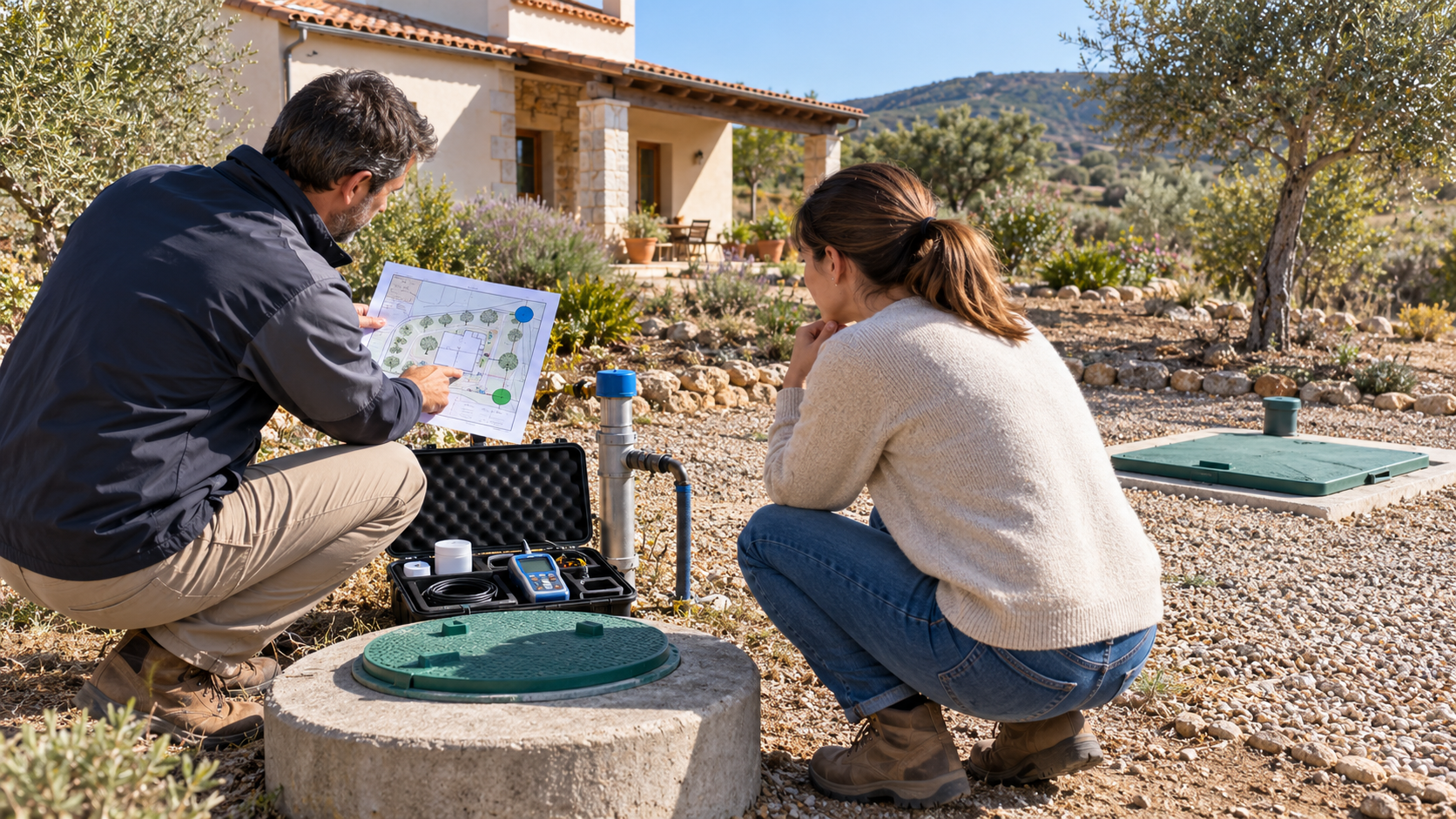
AI-generated editorial illustration of a water-supply and off-grid wastewater inspection; it does not depict a specific property or confirm that the systems are lawful or working properly.
The phrase “the house is fully self-sufficient” sounds attractive, but a buyer must turn it into a set of verifiable documents. For a well or another private water source, the legal regime, permitted volume and water quality must be clear. For an off-grid wastewater system, its design, approvals, servicing and lawful disposal route must be established. Neither a photograph of a pump nor the seller’s statements replace this review.
This material was checked on 25 October 2026. It helps formulate requests to the seller and specialists, but does not determine the regime of a particular abstraction or wastewater system: that depends on the river basin, plot, intended water use and regional requirements.
Start with a utilities plan, not with the equipment
Ask the seller to mark on a site plan the water source, storage tank, pumps, pipes, treatment points, septic tank or treatment unit, outlet and access for servicing vehicles. Label the purpose of every component. Listings may use “well” for a registered abstraction, an old dug well, a tank filled by delivered water or a shared borehole serving several houses. These arrangements cannot be assessed in the same way.
Record how the water is used: drinking and cooking, sanitary needs, swimming pool, irrigation or a combination. Establish whether there is also a municipal connection and how sources are switched. If shared urbanisation infrastructure serves the house, request usage rules, contracts, charges and debt information instead of treating it as wholly private.
Water rights: which evidence to request
Spanish water law distinguishes public water resources and limited cases of water use on a property. The physical existence of a structure therefore does not prove a current right to take any volume of water. The competent authority is normally the relevant river-basin confederation or regional water administration. The proper authority is determined by location and basin, not by the nearest city’s address.
Request a copy of the registration, permit, concession or other document relied on by the owner. Compare the holder, cadastral or other site description, abstraction coordinates, purpose, maximum volume, term and special conditions. Check whether the right transfers with the property and which notice or re-registration is required. If the seller says no permit is needed, ask an independent lawyer to explain the applicable exception in writing.
Articles 54 and 59 of the consolidated Ley de Aguas provide the framework for private water use. Technical requirements for discharge applications are set out in Article 246 bis of the Reglamento del Dominio Público Hidráulico. The official portal of the particular Confederación Hidrográfica must also be checked for the property, because forms and competence depend on the basin.
The physical abstraction must match the documents
A technician should locate the installation on the plot and compare it with the coordinates and characteristics in the documents. Record depth, pump type, installation date, capacity, meter and dry-run protection. Request maintenance and repair logs. A mismatch of location, purpose or construction must not be dismissed as an immaterial formality before specialist review.
Assess resilience separately. A single demonstration of running tap water does not answer questions about seasonal water-level falls, power cuts, tank capacity and system recovery time. Ask how the property was supplied in dry months, whether volume restrictions apply and what backup arrangement exists. Bills for delivered water and repairs are more useful than the oral statement “there is always enough water”.
Water quality cannot be judged by taste
Clear water may still be unsuitable for drinking. Request a recent laboratory analysis identifying the sampling point, date and tested parameters. A competent specialist should interpret the result for the intended use. A domestic filter or softener does not guarantee removal of every possible contaminant.
Establish the treatment train: mechanical filtration, disinfection, softening, reverse osmosis and reserve supply. For each component obtain the model, consumable life and servicing schedule. Inspect chemical storage and safe access. If drinking water is supplied separately, its recurring cost and logistics must be expressly included in the household budget.
Off-grid wastewater: trace the entire route
The word “septic tank” is often used for different arrangements: a sealed holding tank, settlement tank, local treatment plant or an old soakaway. Request the design, approval documents, plan and manufacturer’s instructions. An engineer should identify the actual type, capacity, condition, discharge point or sludge-removal method. A buried system does not become lawful merely because it has long been used.
Check whether the chosen wastewater method is permitted and complies with its document conditions. Discharge to soil, a watercourse or another receiving body may need separate authorisation and compliance with standards. Absence of smell is not proof of proper operation. Overflow, leakage and an improper outlet may appear seasonally and create health and environmental risks.
What to inspect on site
- covers, ventilation, overflow traces, wet areas and ground settlement;
- distance and terrain between abstraction, wastewater system and buildings;
- alarms, pumps and power supply where the system depends on electricity;
- vacuum tanker access, possible hose length and load-bearing capacity of the approach;
- pump-out history, service reports and documents of the lawful operator;
- the ability to repair without demolishing a terrace, garden or retaining wall.
Match the inspection to the house documents
Compare the installations’ positions with cadastral and municipal material, building documents and the plot’s actual boundaries. Extra care is needed where pipes or access cross neighbouring land: clear access rights and easements are required. A neighbour’s promise to admit a service vehicle is not equivalent to a registered right that survives a change of owner.
If connection to a new public network is compulsory in the area, establish the timing, works cost and future of the existing system. Ask the municipality about planned infrastructure and owners’ obligations. Do not price the house on the assumption that the private system will remain permitted indefinitely.
Building a realistic ownership budget
Do not use a universal “annual cost”. List the actual operations: pump electricity, water tests, filters and chemicals, equipment servicing, pump-out and disposal, delivered water, access repairs and a reserve for replacing key components. Obtain a local quotation for each item, including tax and call-out terms.
Assess capital risks separately: replacing a pump, treatment unit or tank, rehabilitating the well, regularisation or connection to the public network. Cost depends on geology, access, design and administrative procedure. A neighbour’s example is useful only as a list of questions, not as a budget.
Checks before paying a deposit
- Obtain a complete water and wastewater plan with photographs and site positions.
- Verify the abstraction right or permit with the competent basin authority.
- Compare the permitted volume and purpose with your occupancy scenario.
- Commission independent water analysis and a technical equipment inspection.
- Identify the wastewater-system type, lawful discharge or disposal route and service history.
- Check municipal requirements, vehicle access, easements and future networks.
- Put required works and administrative steps into the transaction conditions.
If a document is missing or data conflict, the safe conclusion is not that “everything can be sorted later”, but that the procedure, time, cost and likelihood of success must be established before obligations are assumed. An independent lawyer checks the legal regime, an engineer checks the physical system, and the competent water and municipal authorities confirm administrative requirements.
The material is for informational purposes only. Check the legal and financial terms of a specific transaction with relevant specialists.
Select real estateDiscuss with Laverna