
Tiger mosquitoes and terraces: a preventive routine for Alicante owners
Prevention starts with clear care of places where water collects, not a promise to rid a home completely of insects.
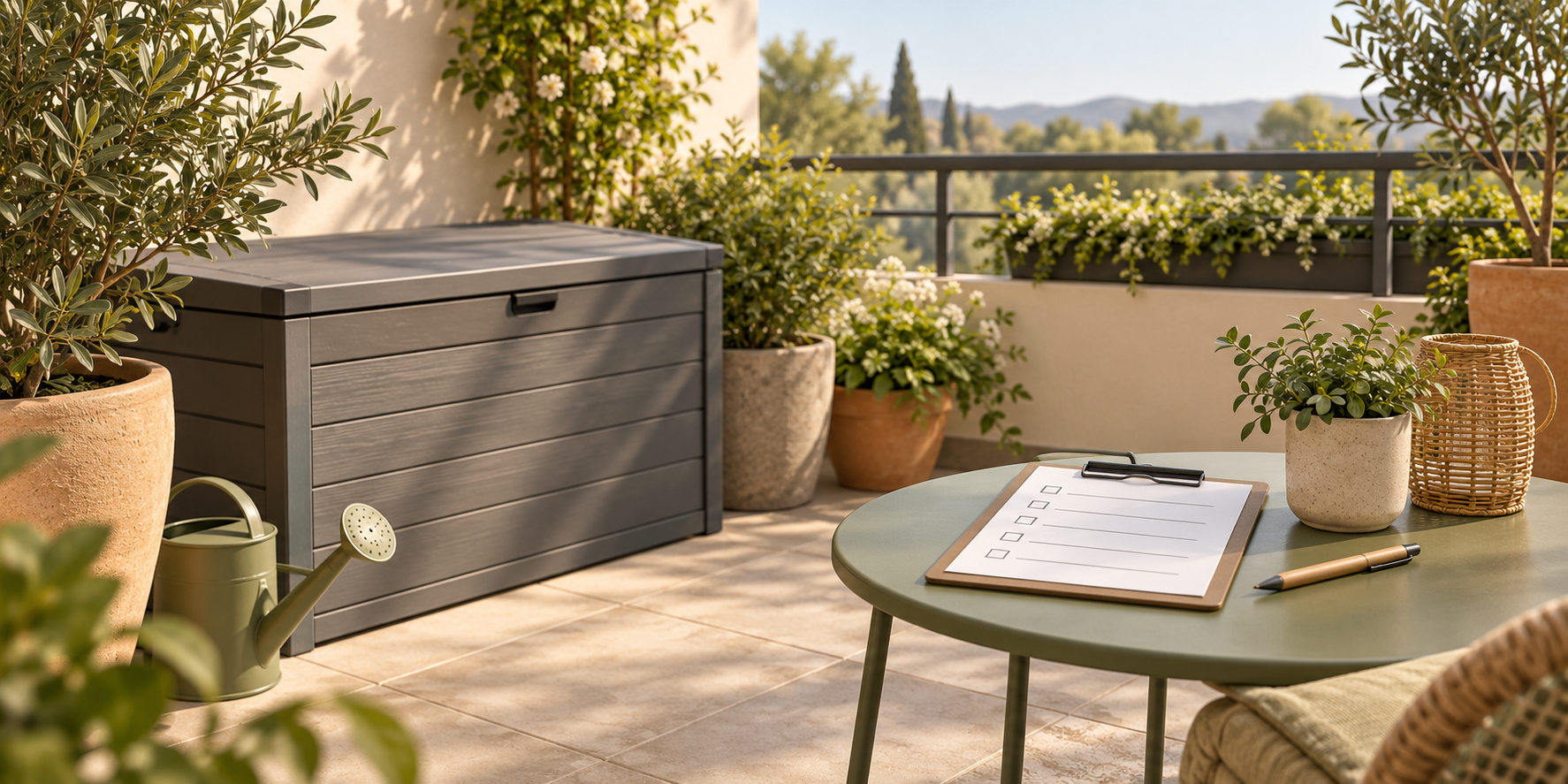
Neutral editorial illustration created with AI: an illustrative terrace with plants and tidily stored containers. It is not a photograph of a particular home, an insect survey result or a guarantee that breeding sites are absent.
A terrace can look well maintained while remaining awkward to inspect regularly: a saucer is hidden behind a planter, a forgotten bucket stands in a corner and it is unclear where water remains after watering. The owner's preventive task is neither diagnosing a single bite nor spraying everything with chemicals. It is more useful to arrange the space so that possible water accumulations are visible and ordinary tasks do not fall between the owner, residents and maintenance company.
This article concerns the organisation of a terrace, balcony or small courtyard in Alicante and Comunitat Valenciana. It draws on official recommendations but does not report a current disease outbreak or infestation at any specific site. It contains no pesticide recipes, dilution methods or medical diagnoses. General upkeep does not replace municipal or specialist advice when signs of a problem cannot be addressed by ordinary safe cleaning.
Why small accumulations of water receive attention
In the official Conselleria de Sanidad answers about the tiger mosquito, breeding sites are associated with small containers and places where water remains close to people. Examples include buckets, plant saucers and drainage elements. The same page says activity in Comunitat Valenciana depends on weather, can occur throughout the year and is generally higher from May to November. This is a general description, not a prediction of mosquito numbers on your terrace today.
Do not therefore reduce the issue to garden size or distance from the sea. Particular objects and areas capable of holding water matter more in a household check. Finding a container does not prove larvae are present, and seeing an insect does not establish its species or ability to transmit infection. Separate prevention from a specialist's conclusion: removing an unnecessary place where water collects does not require declaring an “infested home”.
This differs from assessing water supply or meter consumption. The subject is neither drinking-water quality nor detecting leaks from a graph, but the arrangement of outdoor household items. Water that looks clean should not be excluded from attention. Do not use transparency, smell or the absence of visible movement in a container as household proof that biological risk is absent.
What Alicante's municipality recommends
In the Ayuntamiento de Alicante notice of 3 July 2026, updated on 3 August, residents are urged to prevent standing water, periodically empty and clean saucers and outdoor containers, maintain drainage, cover tanks and report possible breeding sites to municipal services. It separately calls for daily renewal of pets' water. The notice describes a summer campaign and the role of private land; it does not confirm conditions at a particular address on this article's date.
We use its everyday preventive guidance without turning references to treatment into instructions for owners to spray substances themselves. Pools, water-collection systems and difficult-to-reach areas need their appropriate maintenance arrangements. A random action suggested in a neighbours' chat is no substitute. Nor does the announcement of municipal work mean specialists automatically monitor your private terrace.
Make the space easy to inspect
Start with the safely accessible part of your own property. Consider which items genuinely need to be outdoors and which remain after repairs, repotting or earlier visits. You need not move everything at once or rearrange the entire terrace for one checklist. First make a short list of easily forgotten places and establish where you have lawful, safe access.
It helps to divide the terrace mentally into plants, storage, relaxation and drainage. In each area record objects and circumstances, not “mosquitoes”: a saucer, open container, fold in a cover or patch retaining water after watering. This is a list of observations, not a finding of a breeding site. Precision makes it easier to explain the task without alarming, unsupported statements.
If furniture or heavy objects obstruct part of the space, do not risk injury to reach it. Arrange help or a suitable planned move. Do not go beyond barriers, climb onto a roof or open shared technical rooms yourself. Good prevention must not create another hazard, particularly in an upper-floor apartment or an awkwardly accessed terrace.
Plants: agree the whole care cycle
Owners need to know not only who waters plants but what happens afterwards. Include checking accessible saucers and containers in arrangements, following guidance to prevent standing water. Do not assume the gardener, cleaner and resident have automatically divided this work among themselves. If each thinks it belongs to someone else, small repeated tasks are easily missed.
When buying new planters, consider whether ordinary care and inspection will be possible without dismantling an elaborate arrangement. Attractive decoration must not turn every check into a difficult technical operation. This concerns ease of maintenance, not a recommendation for a particular pot design. If a plant or irrigation system needs special conditions, agree the solution with a competent provider rather than changing the regime randomly.
Do not add household chemicals, oils or other substances to saucers as a homemade control method. This article offers no such recipes. If removing unnecessary water accumulation and ordinary care do not resolve the issue, establish the professional route. Do not replace a product's authorised purpose with an assumption that “a little cannot hurt” plants, animals or people.
Items left outside after use
A bucket, watering can, toy or household accessory should have a clear place after the job. The aim is not to deprive the terrace of useful things but to stop them becoming forgotten water collectors. Choose a solution suited to the object's shape and safe storage. Do not block passageways or exits merely to put everything in one corner.
After rearranging, receiving guests or completing small jobs, revisit the usual areas. Changes to the normal routine often leave new objects unnoticed. This requires no report with dozens of photos: establish what has appeared, who uses it and how it will be stored. Do not invent an unverified “treatment” frequency when the issue is simply organising possessions.
A lid or cover also requires attention to actual condition. Do not regard an item as dealt with merely because the list says “covered”. If storage itself creates water retention or hinders maintenance, discuss a suitable solution. Do not invent one universal arrangement for every tank: purpose, design and access requirements may differ.
Shared building elements and neighbouring land
First establish whether the observed area belongs to your apartment or is common property. If it concerns shared drainage, a garden or pool, inform the maintenance contact. A useful message gives place, date and a clear observation, such as water remaining in a visible area after ordinary use. It should not accuse a particular neighbour of spreading disease.
Do not climb onto somebody else's terrace or photograph neighbours' private lives to prove suspicions. A report needs relevant information obtained lawfully and safely. Inspecting closed land requires agreed access, not unilateral action. Do not spray beyond your boundary or interfere with common systems.
In community discussions, distinguish three tasks: household care of private space, maintenance of a common element and contacting municipal services. They may be connected, but completing one does not complete the others. A group-chat message does not prove a specialist accepted a request, and an entry in a work plan does not mean the particular area has been inspected.
When the owner leaves for a long period
Before leaving, go beyond “keep an eye on the terrace”. Prepare a short list of accessible places and actions agreed with the helper. State what has been stored away, what remains outside and whom to contact about new questions. Such a handover is especially useful when one person waters plants and another looks after the apartment generally.
Do not ask the helper to work at height, open technical assemblies or apply unfamiliar substances. Their authority and ability must be clear beforehand. If a professional inspection is needed, agree who arranges it and how access will be approved. Having keys to the apartment does not mean someone can safely maintain every system.
On return, check actual conditions rather than just a message saying “all fine”. Ask what was observed, what changed and whether questions remain. This is not judging another person's diligence through guesses, but rebuilding a clear picture of care. Do not turn absence of complaints into a promise that there are no insects on the property.
When and how to report an observation
Alicante's municipality asks for reports of possible breeding sites. Describe the accessible observation and location without claiming more than you know. “Many insects seen near this area” and “confirmed tiger mosquitoes transmitting infection” are very different statements. Household impressions or a photograph of a bite must not replace species identification and assessment.
Prepare the date, precise location and whether the space is private or communal. If you have a safely obtained image, ensure it relates to the observation and discloses no unnecessary personal data. Do not use this article's illustration as evidence. Keep confirmation of the report if provided, and ask about the next steps without promising neighbours immediate treatment.
For health questions after a bite, consult a medical professional; a household terrace check does not diagnose. On selecting an individual repellent, the official Conselleria guidance refers to a doctor or pharmacist and the manufacturer's instructions. We offer no particular active ingredients, application regimes or universal product for every age and situation.
Prevention is a process, not a “no insects” tick
Describe the outcome concretely: unnecessary items stored away, accessible containers included in care, responsibilities clear, common-element questions passed to the responsible person and necessary reports retained. These are verifiable actions. “The terrace is completely protected” is much broader and cannot be established by one inspection or completed checklist.
The purpose is to reduce forgotten places and help notice changing conditions in time. It promises neither absence of bites or vectors nor that further action will be unnecessary. Keep observation linked to action: what you saw, what you safely did, what you referred to a specialist and what still awaits a reply. Care then remains a sensible part of ownership rather than alternating alarming rumours and random treatments.
Sources and scope of verification
On 29 October 2026, we read the official Conselleria de Sanidad questions and answers and the Alicante municipal prevention notice published on 3 July 2026. Seasonality is presented as a general statement from the regional source, not a current forecast. The household organisational questions were developed editorially. No particular address, insect species, epidemiological situation or treatment results were checked here.
The material is for informational purposes only. Check the legal and financial terms of a specific transaction with relevant specialists.
Select real estateDiscuss with Laverna