Carbon monoxide at home: what owners should organise before using appliances
The absence of smoke or smell does not confirm the absence of CO. A practical owner framework: equipment, manuals, a professional and information for occupants.
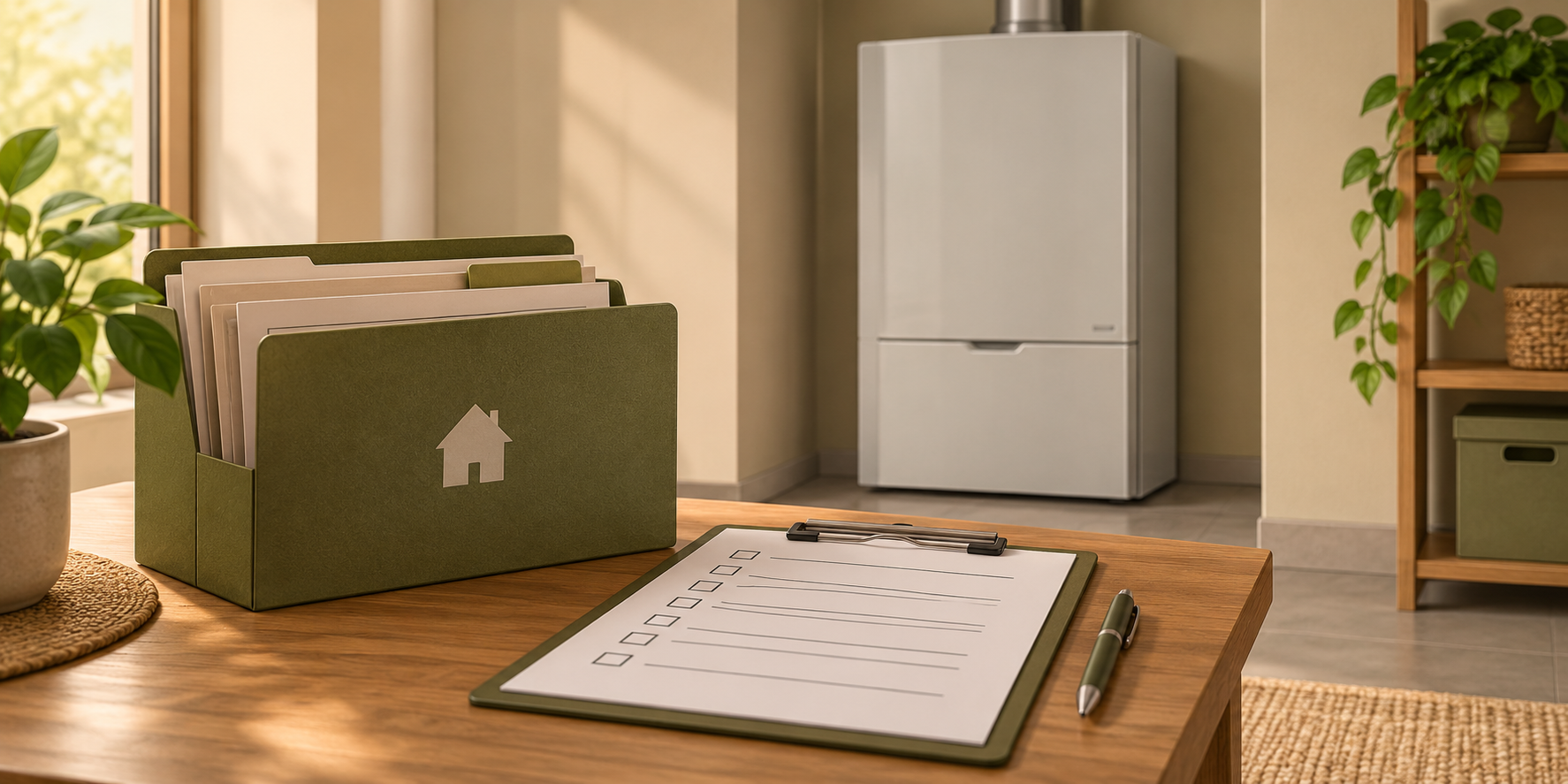
Neutral editorial illustration created with AI: an imagined room with heating equipment and an instruction folder. It is not a photograph of a particular installation, an installation diagram or confirmation that a home is safe.
If a CO alarm sounds or carbon monoxide exposure is suspected, this is not the time to work through a home checklist. Move into fresh air, do not stay to look for the source, and call emergency services on 112. Do not return until emergency services give permission. Follow their instructions; this article does not provide treatment instructions or guidance for attempting a rescue in a dangerous atmosphere yourself.
An owner's preventive work begins earlier: understanding which equipment burns fuel, who is responsible for professional servicing and which operating conditions must not be changed by guesswork. An attractive interior, hot water and a freshly painted wall beside a boiler say nothing about whether the installation has been checked. Recovering this information is especially important when buying a home with existing equipment, after alterations or before returning to a long-empty property.
Below is a way to organise documents, questions for a professional and information for occupants. It is not a remote assessment of a particular apartment, a repair guide or a list of every mandatory check for every model. Your equipment needs its own instructions, applicable requirements and a competent professional. General advice must not become permission to switch on an unchecked appliance.
Carbon monoxide is not visible smoke
Spain's National Institute of Toxicology and Forensic Sciences explains that carbon monoxide, CO, has no smell or colour. It can form when fuel burns incompletely; possible sources include boilers, gas water heaters, stoves, fireplaces and engines. The absence of visible smoke or a familiar smell therefore does not confirm the absence of CO. You cannot assess the air through your own senses.
For household organisation, this means fire-safety checks and carbon monoxide questions should not be merged into a single “everything checked” tick. Reject the informal test that “if nothing smells, it is working properly”. Do not try to determine the concentration from the colour of the air, another person's condition or how long an appliance has been running. These observations do not replace professional checks or action on an alarm.
The same institute recommends proper installation and regular equipment checks, unobstructed ventilation grilles, using appliances for their intended purpose and certified professionals for alterations to gas installations. Its preventive advice includes annual checks of boilers and heating appliances. This does not make all legal maintenance intervals identical: the particular schedule and scope should be established for the system type and current requirements.
List the equipment, not assumptions
Start with appliance documents. Record purpose, make and model where these are available without dismantling: hot water, heating, cooking or another use. Note whether the fuel is known and where the instructions are kept. If you are unsure of the system type, leave that question for a professional. Do not remove casings, disconnect pipes or turn equipment on merely to complete the list.
Do not limit the list to the most visible appliance. There may be a separate water heater, fireplace, portable appliance or equipment inherited from the previous owner. The aim is not to diagnose each item, but to remember to ask about it. A photograph of accessible identification markings can help locate the correct manual, but does not itself confirm the installation's suitability or reveal hidden components' condition.
For a shared building system, establish separately whom to ask about servicing and which documents an owner can obtain. Do not combine records for central equipment with those for an appliance inside the apartment. Work recorded in one place does not automatically describe another. If responsibility is unclear, record a question for the manager or maintenance company rather than intervening in shared systems yourself.
Recover the service history before use
Ask for records of recent work and read which equipment and actions they actually describe. An invoice for a visit, replacement of one part and a full system inspection are different records. Do not attribute a meaning the document does not contain. If the previous owner says “everything was serviced recently”, clarify who did it, when and what was done rather than relying on a verbal promise.
A useful home table has four entries for each appliance: document, what it confirms, what remains unknown and whom you have asked. This shows which parts of the history are known and which still need investigation. Missing paperwork does not prove a fault, but neither justifies declaring equipment checked. If you doubt its operation, consult a professional before further use.
When requesting a service, describe the whole task: you want to understand the condition and requirements for safe use of an existing appliance, not merely get it to turn on. Clarify which professional is suitable for the system, what the inspection includes and what findings will be documented. Do not devise your own technical tests or demand a “certificate of no risks whatsoever” that cannot reasonably be issued through household correspondence.
Ventilation and alterations: do not quietly change operating conditions
Galicia's health service, SERGAS, links CO risk to combustion appliances operating in insufficiently ventilated spaces and stresses maintaining equipment and ventilation ducts according to the manufacturer's instructions. Its advice specifically prohibits using a gas oven to heat the home or running fuel-powered engines indoors. We do not reproduce regional statistics from this material or infer the condition of a particular home.
Before changing a kitchen, installing furniture or enclosing part of a room, include equipment and ventilation in the project discussion. Do not let a decorative task quietly change an appliance's operating conditions. The contractor's brief should explicitly identify combustion equipment and the need for professional assessment of affected decisions. This is a matter for coordination, not instructions for the owner to calculate ventilation themselves.
After work, compare what was done with what was agreed: have new questions arisen about equipment position, service access or ventilation elements? Do not test draught with flames, smoke or deliberately adverse conditions. If doubts arise, refer them to a professional. An open window must not be treated as a homemade remedy for an unknown installation problem.
Identify alarms' functions from their documentation
A device on the ceiling or wall cannot be assumed to detect carbon monoxide from its appearance. Record separately what the manufacturer claims: smoke detection, CO detection or several functions. Do not assign an unstated CO function to a smoke alarm. Missing markings or instructions are a question to resolve, not a completed tick for carbon monoxide protection.
The US Consumer Product Safety Commission, CPSC, treats a CO alarm as additional protection, not a substitute for correct use and maintenance of fuel-burning appliances. It recommends following the manufacturer's instructions and notes that the test button does not establish sensor accuracy. US installation standards and local legal requirements in this source are not presented here as Spanish rules.
The owner's organisational task is to keep the correct model's manual, installation information and power-supply and replacement details specified by its instructions, and explain signals to occupants. Do not replace a particular device's documentation with general internet advice. Do not test it with exhaust, flames or burning materials. An alarm must not be ignored to finish dinner or calmly complete a paperwork check.
When handing the home to another person, show where instructions are kept and how to respond to an alarm according to them and emergency services' directions. Do not settle for “it just beeps sometimes”. If a signal's meaning is unclear, do not declare it harmless based on another model. Questions about a faulty device must not be confused with a potentially dangerous atmosphere.
Prepare clear information for residents
A short note must relate to the equipment actually present. State where the manual is, whom to contact for servicing and which appliances must not be used until a professional authorises it. Do not list technical actions that guests cannot perform safely. The aim is not to make everyone a repairer, but to avoid leaving someone alone with an unfamiliar system.
Check the language and clarity. An instruction nobody living there understands offers little help in a real situation. Preserve warnings and restrictions when translating; do not reduce them to “use carefully”. Your short note supplements the original manual rather than replacing it or cancelling a prohibited operating mode.
For an owner living elsewhere, a realistic contact procedure matters particularly. Messaging the owner remotely must not be a compulsory first step before calling emergency services. Do not promise a phone notification will definitely arrive or that viewing an app remotely permits you to authorise re-entry. Decisions in a dangerous situation are made with emergency services, not for the owner's convenience.
Separate preventive tasks from an emergency
Andalucía's official emergency service directs people to 112 in an emergency and recommends following the competent services' instructions. CPSC advises moving into fresh air on a CO alarm, not searching for the source yourself and not returning without emergency services' permission. For Spain we give 112, not the US number in the source. Do not delay calling while looking for a warranty card or photographing the appliance.
This article deliberately provides no symptom checklist for home diagnosis, concentration thresholds or treatments. How you feel is not a household safety meter, and an alarm's silence does not replace professional assessment when exposure is suspected. If the situation already causes concern, put the preventive folder aside. Do not enter a dangerous area to save belongings or investigate yourself.
After an incident, do not treat the signal stopping or airing the room as permission to use the equipment again. Re-entering the room and returning an appliance to operation are different questions. The toxicology institute calls for certified professionals to check the installation before use resumes after a CO incident. Keep instructions received and work records instead of substituting your own test switch-on.
What useful preparation produces
The result should not be an abstract “home is safe” status, but clear information: what equipment exists, which manuals apply, who services it, what documents confirm and which questions remain open. Unknowns are identified plainly. Occupants have an understandable way to seek help, and the owner has a plan for professional clarification rather than home experiments.
Update the folder after appliance replacement, work affecting operating conditions and new documentation. Remove information about dismantled equipment from the current note while keeping history separately. This does not eliminate risk, but helps prevent an old manual, someone else's promise or an appliance's appearance being mistaken for current evidence of the system's condition.
Sources and scope
Checked on 29 October 2026: Spain's National Institute of Toxicology and Forensic Sciences, SERGAS guidance on carbon monoxide, Andalucía emergency service recommendations and CPSC questions and answers about CO. Document organisation and owner questions are a practical editorial framework, not a technical inspection report, medical consultation or confirmation that a particular installation complies with standards.
The material is for informational purposes only. Check the legal and financial terms of a specific transaction with relevant specialists.
Select real estateDiscuss with Laverna