
Water meters and consumption alerts: an Alicante homeowner's plan
An unusual-use alert is a reason to investigate, not a diagnosis. A practical framework for data, contacts and the owner's confirmed actions.
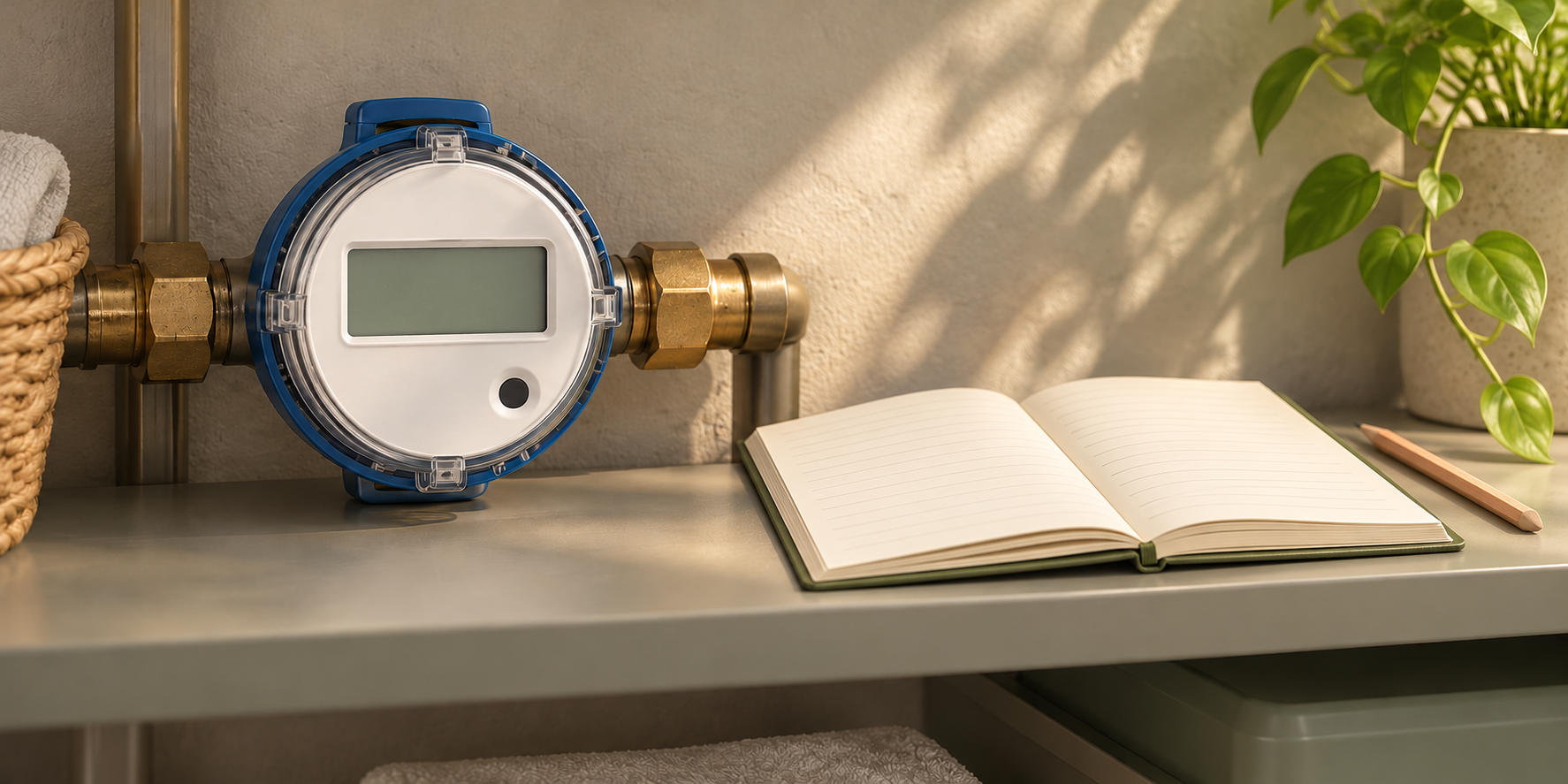
Neutral editorial illustration created with AI: an imagined water meter and record sheet on a light background. This is not a real device, a particular apartment's reading or a screenshot of an Aguas de Alicante customer account.
Unusual water use often first appears as a question: why is the figure different, what does a notification mean and which period does it cover? A useful response begins neither with “definitely a leak” nor a promise that an app will detect everything. First connect the contract, meter, reading date and circumstances of the home's use. Then establish what information exists and whom to ask a specific question.
This article concerns consumption records and organising checks for Aguas de Alicante customers. It does not assess drinking-water quality or replace SINAC information, a pipe inspection or the calculation rules for a particular bill. Remote data and notification availability must be checked for your own contract and equipment. An operator offering a feature does not prove it is active in every apartment.
Which functions the operator describes
On the official page about telelectura Aguas de Alicante explains periodic remote meter reading and access through the customer area. Features include viewing consumption, comparisons and activating alerts for increased use or a possible leak. We read the Valencian-language page on 29 October 2026. This describes a service; we have not checked a particular customer's equipment or settings.
In the official transaction catalogue there are separate options for submitting readings, viewing consumption history, managing contracts and digital notifications, enquiries and tracking their status. Some are marked as available in the private account. The catalogue does not show whether a particular address has hourly records, when data last updated or which alerts are active. One general link cannot settle those questions.
In the publication dated 5 December 2024 the operator described customer-configurable notifications and separate company messages about continuous use, stressing up-to-date contact details. That publication presented full remote-reading deployment as a goal, not an already achieved state. Its historical percentages, trigger intervals and savings figures are not presented as your contract's current parameters.
First connect the address, contract and meter
Place the latest relevant bill beside the available contract information. Check that you are looking at the right address and supply point. If the family has several apartments or the account contains several contracts, label your working note clearly. Another home's consumption chart, even opened accidentally from your own list, does not explain the apartment you mean to investigate.
The page about checking a possible internal leak states that the meter number is at the bottom of the bill. If a leak is found, the operator also suggests contacting a repair service and reporting the fault to it for consideration of the effect on consumption. This does not promise an automatic bill adjustment. We do not reproduce the page's steps involving taps and the meter: this is not a plumbing guide.
If the meter can be accessed safely and lawfully, compare its identification with the documents without dismantling or interfering. For unclear markings, locked meter rooms or a group of neighbours' meters, ask the responsible person. Do not choose one merely because it is nearest the apartment. Do not break seals, remove connections or try to correct a mismatch yourself.
Find out which data you can actually access
Using your own authorised access, check what is displayed for the right contract. Record whether consumption history is available, the period and detail shown and its latest date. If the section is missing, ask the operator. A missing chart does not prove zero use, a broken meter or an absent service; the cause remains unknown.
A useful enquiry is: “For this contract, I would like to clarify remote-reading availability, the detail provided and how current the data is. Where can I see when the latest reading was received, and which notifications can I activate?” This does not require asserting that the system must display consumption every minute. Access to the account at any time is not a guarantee that every figure updates instantly.
If readings work differently or the online feature is unavailable, ask for the official submission and checking procedure for your case. Do not invent a value to fill a required field or copy an old figure as a new reading. Keep the reply explaining the permitted route. Monitoring begins with a genuinely available method, not a promised feature in old advertising.
Distinguish a reading from consumption over a period
Name each item literally in your working note. The reading displayed on the meter, consumption during a selected interval and the bill amount are different quantities. Add the date, source and unit exactly as shown in the document or interface. If you do not understand what the display means, clarify first. Two figures cannot be compared merely because they appear in similar boxes.
Before comparing periods, check their beginning and end. A week with a large family staying and a short vacant interval describe different circumstances. Do not declare a fault solely by comparison with an arbitrarily chosen earlier record. Add confirmed events such as occupation, agreed work, irrigation or other known water use. This provides context, not a ready-made explanation for any amount consumed.
Do not alter source data to make the chart look logical. If a meter was replaced, a period is incomplete or figures appear incomparable, record a separate question. Keep the original document apart from your notes. Honest uncertainty is more useful in discussion with the operator than an attractive table based on guesses about missing data.
Notification settings also need checking
If the service is available, read which notifications it offers and what each means. Save the chosen parameters and setting date so you can later understand a message's conditions. Do not copy a random threshold from another home. If unsure, ask how settings relate to available data and usual use, without expecting one universal value for every household.
Check that notification contact details are current and who actually reads the messages. Entering an email address is not enough: agree who will notice the alert, contact the operator and arrange an on-site inspection. Do not share a password for convenience; if someone else needs access, ask about the operator's authorisation process.
Do not create artificial consumption to trigger an alert or cause a leak to “test the system”. If you need to confirm saved settings or a correct contact channel, ask for the standard checking method. The absence of a message is not a certificate that the entire internal network is sound. An alert is a reason to investigate, not a replacement for maintenance and attention to the actual situation.
Received a message? First read what it says
Keep the text, receipt time and period identified. Check whether it concerns a chosen threshold, continuous use or something else. Do not describe it as a “confirmed emergency” if it only reports a possible anomaly. Equally, do not postpone checking simply because no water is visible: a lack of visible signs does not explain the data.
Enter the customer area through your usual official route, particularly if an email unexpectedly requests account details or payment. Compare the alert with available history and known circumstances. If work was taking place, establish its timing and nature; do not attribute all use to repairs without evidence. Keep the distinction between an assumption and an established fact visible in your notes.
If active damage is occurring or there is danger, do not wait to finish analysing a chart. Arrange the necessary professional help; do not enter dangerous flooded areas or interfere with equipment you cannot handle safely. Urgent repairs, data checks and billing may follow different routes, none of which replaces the others.
Prepare a short enquiry for the operator or professional
For a first substantive enquiry, it usually helps to state the question, period and reason for doubt: “I received this notification for this contract. The history shows this interval. The known circumstances are as follows. Please explain the data and the next checking steps.” Send full identifying details only through an official secure channel and only as needed, not in public discussion.
Separate the questions. Ask the operator about readings, service availability, notifications and enquiry procedures. Ask the relevant professional to inspect the internal installation and repair within their competence. If shared building elements are involved, clarify the manager's or responsible organisation's participation. Do not decide responsibility merely from where water was noticed without assessing the circumstances.
Keep the enquiry number, reply and agreed next actions. If photos or documents are needed, send relevant material without exposing neighbours' data. A useful photo records a particular observation; an article's generated image is not evidence. Do not change a photograph's date or label a suspected cause as professionally established.
How to close the issue after checking
Record what was established: whether the consumption explanation was confirmed, whether a fault was found, what work was done and which documents were received. “A technician visited” is insufficient if you do not know what they checked and did. But a repair bill is not automatically an answer about a particular charge either. Keep technical findings separate from consumption-record correspondence.
After the agreed actions, look at subsequent available data in comparable circumstances. If alerts continue or information remains unclear, return to the enquiry with a new date and fact rather than restarting without reference to the previous case. Do not assume every post-repair difference equals savings: comparable periods and usage circumstances are needed for that conclusion.
For a frequently vacant home, a contact and professional-access arrangement agreed in advance with the owner's permission is useful. It does not require round-the-clock observation of other people's lives. Do not infer categorically who is in the apartment or what they are doing from water use; a chart alone does not prove that. Resource monitoring should remain a maintenance task, not a pretext for unsupported accusations.
What the owner should retain
A good result is a clear chain: contract, meter, date, information and action. You know which features are available, where to check them, who receives messages and how to arrange professional examination. Unknown parameters remain identified as unknown, and a historical technology description is not passed off as proof it works in your home.
This approach promises neither detection of every leak, freedom from damage nor reductions in every bill. It helps formulate questions sooner and distinguish consumption, readings, alerts and final findings. This is particularly useful when ownership or household paperwork responsibility changes: the next person receives a clear history, not just a password and disconnected photos.
Sources and scope of verification
Official Aguas de Alicante materials read on 29 October 2026: description of telelectura, transaction catalogue, page about a possible internal leak and historical notification article dated 5 December 2024. No customer account, particular meter or contract settings were checked. The note-taking and enquiry structure above is an editorial framework, not an additional operator requirement or technical diagnosis.
The material is for informational purposes only. Check the legal and financial terms of a specific transaction with relevant specialists.
Select real estateDiscuss with Laverna